
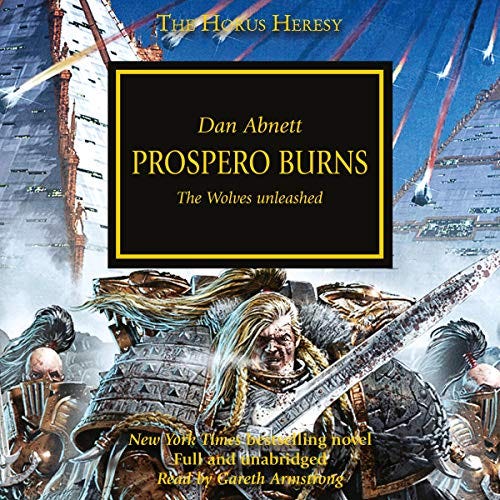
There’s no doubt that within the canon of the Horus Heresy, Prospero Burns by Dan Abnett is a masterwork.
Even if you haven’t read it yet, you probably won’t need much convincing beyond the fact that it’s written by Dan Abnett and is one of only twelve books to be selected for the “Horus Heresy Saga” special reprint cycle. With the second book of the Saga, Graham McNeill’s False Gods, up for preorder this week it will probably be awhile before we get to see the new edition, but being one of a dozen representing a line of 54 books is no mean feat.
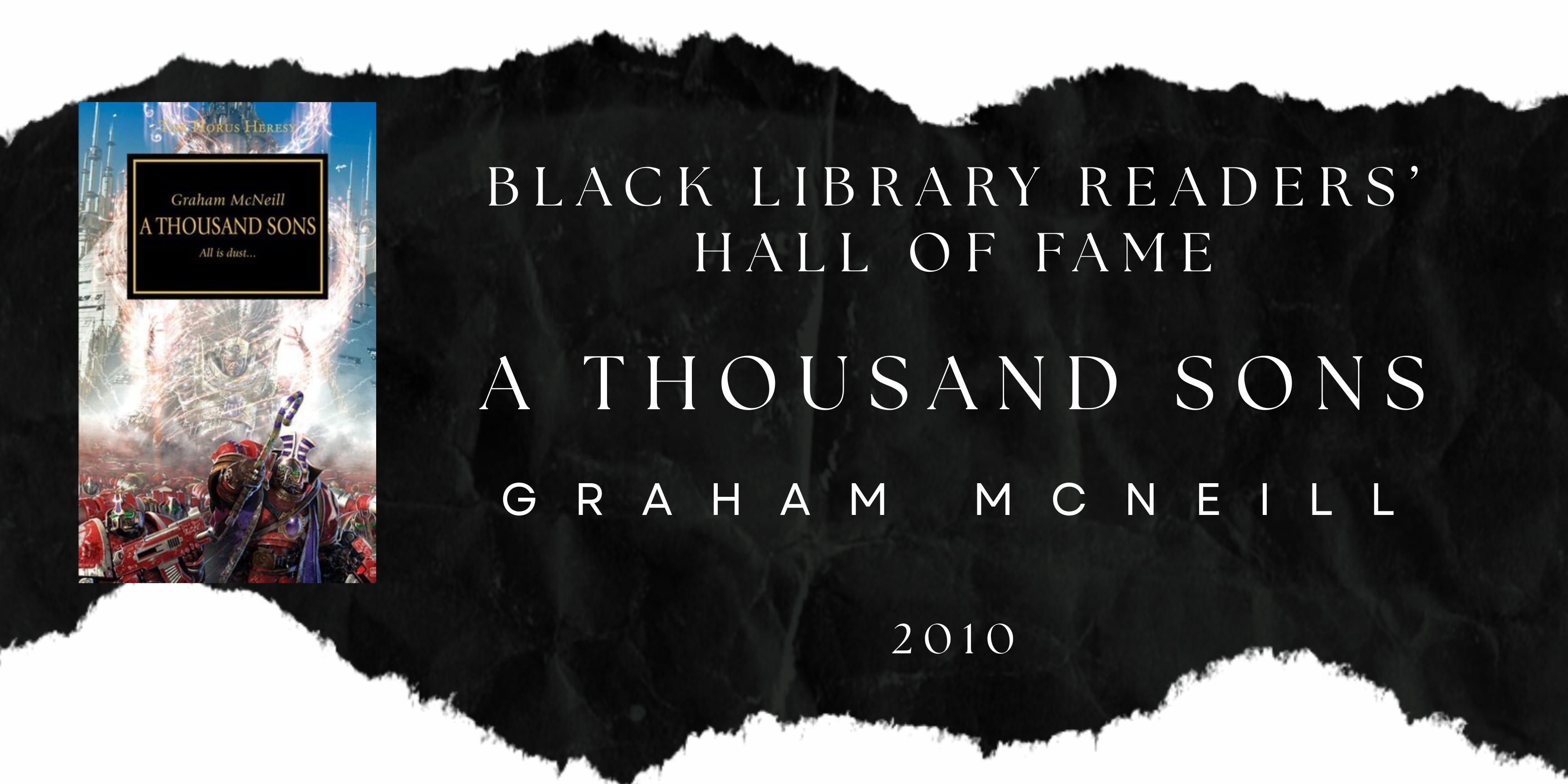
It certainly doesn’t hurt to note that it was recently inducted into the Black Library Readers’ Hall of Fame, either. And while I can’t automatically equate popularity to quality, it does the book’s case for greatness no harm to recognize that it was the first Horus Heresy book to crack the New York Times Bestseller List top twenty (peaking at #161).
Nope, there’s little doubt that Prospero Burns is a monumental work… and I hated it.
Bait and Switch
Okay, that’s an exaggeration, I didn’t actually hate the book. But I often like to say that not every book is for every person, and while I went into this one with high hopes it just wasn’t a book for me.
On the face of it, I was expecting to hear the story of the destruction of Prospero from the perspective of the Space Wolves. It was a terrible tragedy I’d last visited only a couple months ago listening to Graham McNeill’s A Thousand Sons, showing it from the side of the Legion of Magnus the Red. And given this, the official blurb from the Black Library, one could hardly blame me:
The Emperor is enraged. Primarch Magnus the Red of the Thousand Sons Legion has made a terrible mistake that endangers the very safety of Terra. With no other choice, the Emperor charges Leman Russ, Primarch of the Space Wolves, with the apprehension of his brother from the Thousand Sons home world of Prospero. This planet of sorcerers will not be easy to overcome, but Russ and his Space Wolves are not easily deterred. With wrath in his heart, Russ is determined to bring Magnus to justice and bring about the fall of Prospero.
Yup, that sounded exactly like the other-side-of-the-story of A Thousand Sons, a story I enjoyed a great deal, even as I noted that I felt that McNeill’s destruction scene- the very climax of the book- wasn’t quite the emotional payoff I had been hoping for.
Would this be the opportunity to see the tragic event handled with perhaps just a touch more pathos and gravitas? It was a hope.
But not only was Prospero Burns not about the actual destruction of Prospero, but the Thousand Sons themselves barely registered for much of the book!
Too Clever by Half
So that last statement was technically true, but not exactly. And because this is a book that’s almost impossible to discuss without spoilers2, I’m gonna just plow on. If you’ve never read the story and intend to, you might consider hitting the eject button now.
So sure… it’s not “about” the actual destruction of Prospero, and indeed the event is rather anticlimactic at the very end of the book. But as it turns out, the Thousand Sons were very much a part of the story all along- you just had no way to know that until some of the plot twists and machinations begin to be unveiled.
Prospero Burns was Dan Abnett’s third foray into the Heresy, not counting the terrific Blood Games short story from the Tales of Heresy anthology (book ten). His first, Horus Rising, was a very straightforward opening salvo while Abnett dipped into his bag of tricks for Legion. Propsero Burns strongly takes after the second, but unlike Legion this one didn’t feel quite as lean or focused. It meanders more, takes its time to get to its reveals, and dare I say feels a bit more self-indulgent.
Again, not every book is for every person, and that by no means makes it a ‘bad book.’ I often bring up Marc Collins’ Eidolon: The Auric Hammer as an example of this. I didn’t love the book, finding it a bit too uneven and introspective a tale for my liking- only to see it get voted as the runner-up for the Black Library Book of the Year for 2024 on Warhammer Community.
Wet Leopard Growls
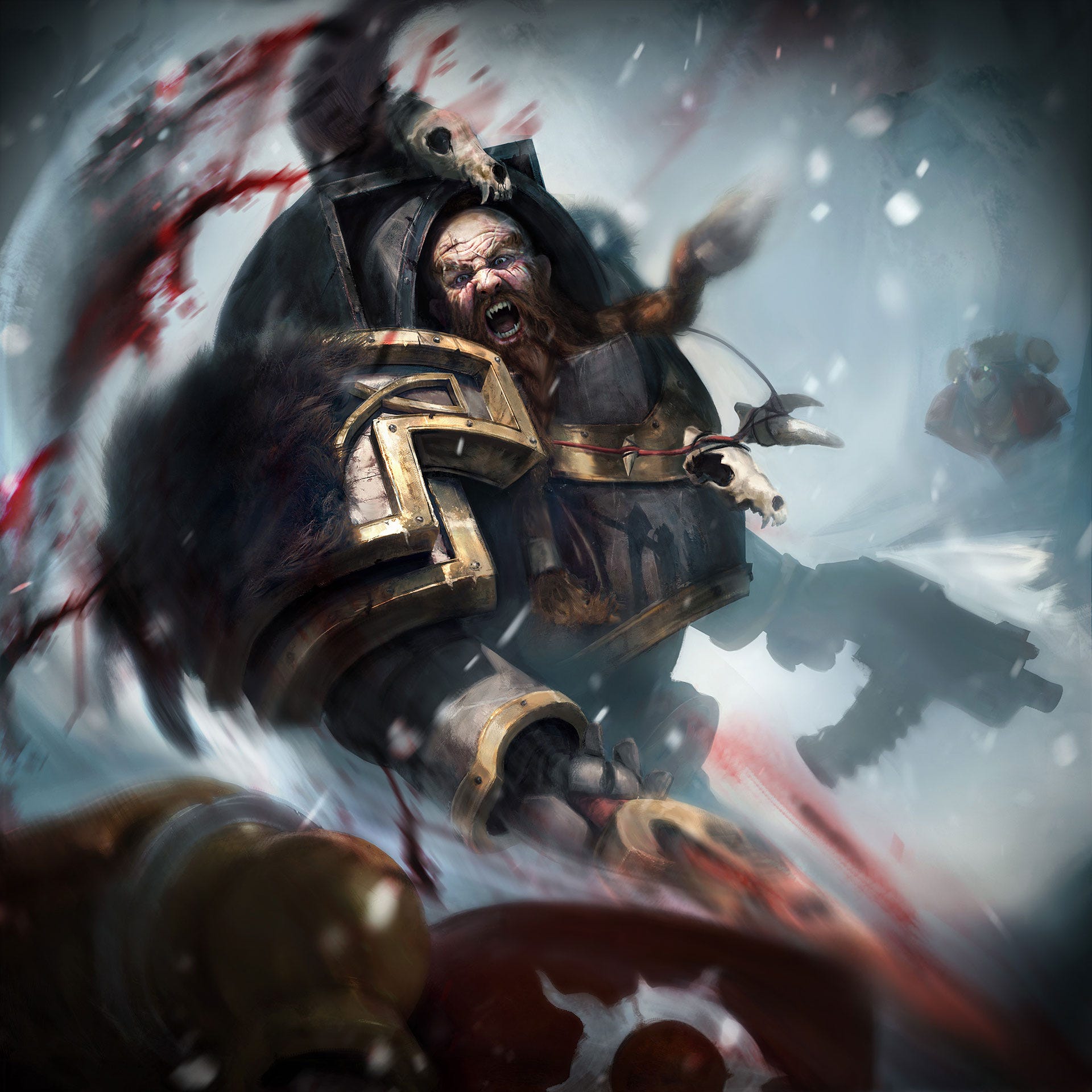
Up until Prospero Burns, I’d thought the readers a bit harsh on Abnett for the term “wet leopard growl.” Sure it’s an unusual phrasing, I thought, but that hardly warrants it getting the full-fledged meme treatment. That opinion changed once I’d listened to it. Repeatedly.
Abnett uses the word “leopard” twenty times in the novel, with sixteen specifically being “wet leopard growl.” With the book being a little over 400 pages in length, you’re getting leoparded every two dozen pages or so. I chuckled the first time I heard it… aha, so here’s where it came from!… and very quickly after that I’d cringe each time I heard it.
Fair play to Abnett, I’d only later learn that he was aiming for something very specific here. The term perfectly evoked the timbre and resonance he was going for in Space Wolf voices, reflecting their feral and predatory nature, and as he shared in a fantastic interview3 with Mira Manga the aim was to employ the term with enough frequency that it faded from active notice in the reader. Abnett compared it to the word “said,” which is employed so frequently that it’s effectively invisible4. Abnett acknowledged that he’d failed in the effort, but it’s interesting to learn that there was a deliberate purpose here even if it didn’t work.
The Falling Sickness
Here’s something else I was amazed to learn, that Abnett had some health struggles that came to a head during the writing of Prospero Burns.
As he wrote in the book’s Afterword in 2014:
During the course of Prospero Burns, I suffered a series of grand mal seizures.
I wound up in hospital, and underwent multiple CAT and MRI scans. For a period of four months, I was awaiting diagnosis, I knew – very calmly – that it might be terminally bad news.
It disrupted my workflow, as you can imagine. That’s why Prospero Burns and A Thousand Sons didn’t come out together, as planned.
Four months in, the specialist said to me, ‘It’s just epilepsy,’ and gave me some pills. I keep taking the pills. I haven’t had another seizure since. Just epilepsy. I’d had it all my life, apparently, and it had just decided to introduce itself formally.
Where it gets really fascinating (in a life-imitates-art-imitates-life kind of way) is how this episode in Abnett’s life gets baked into Prospero Burns. Prospero Burns is a story very much about the unreliability of memory, as experienced by its main character Kasper Hawser. Abnett, again:
Funny thing is, Hawser has a fractured personality. The way I wrote him after the seizures reflected (subconsciously) the way my mind felt. If you look at the work I produced that year, you’ll see a detached notion of self coming to the fore. It wasn’t deliberate.
Thankfully, Abnett was diagnosed and medicated, and at least as of 2014 he hadn’t had a recurrent episode. By the same token, he does note that the medication has altered some essential part of himself.
I am not the same person who wrote Horus Rising and First and Only.
I won’t be that person again.
Then again, this person is the one who gave us that magnum opus, Hive, so I think we’re doing pretty well, Dan.
Glad you are, too.

Giving Voice
This is my fourth exposure to Gareth Armstrong since I’ve begun the Audio Impressions review series, having first profiled him in depth for Mike Lee’s Fallen Angels. He’s like a comfortable old friend at this point, enjoying him for his strengths and happy to look past anywhere he might fall a bit short.
Those strengths and weaknesses are the same as ever. A terrific reading voice, but a rather limited character range:
Whereas some narrators will use accents to differentiate characters, Armstrong instead relies more on pitch and cadence- with much more mixed results… I suspect Armstrong might be a better fit for books with a smaller cast of characters.
Indeed, Prospero Burns actually worked to limit the demands on Armstrong’s range. Hawser does a great deal of the book’s talking, with the cast of Space Wolves characteristically dour men of fewer words.
Bits n’ Pieces
Just one here as we’re already at full-review length. This is the first audiobook I’ve consumed that I wish I’d enjoyed on paper, instead. That’s no fault of Armstrong’s, who as I noted above did a fine job with what he had to work with here.
Rather, it’s more a testament to the story Abnett wanted to tell- or, more accurately, how he told the story he wanted to tell.
Robert Rath’s extraordinary The Infinite and the Divine has a section in it where Orikan and Trazyn are standing before a tribunal and, unbeknownst to Trazyn, Orikan keeps traveling back in time to try and rig the judge selection.
It’s not immediately apparent in the story, but as Rath essentially rewrites the same section multiple times in succession there’s a moment of realization when you, the reader, figure out what’s happening. Having both read the novel and listened to the audiobook recently5, this sequence is a significantly better experience in print. The audio can do a lot of things as well as print… can do a few things perhaps even better on occasion… but what it can’t do well is convey any kind of ‘meta’ writing.
The same thought applies here.
As Abnett grew more and more visually expressive in the story, rewriting the same passage over and over as Hawser’s recollections sharpened, the audio format was less and less effective a medium. Far more often than the use of “wet leopard growl” were the times I wish I was reading the book in print just so I could flip back a page or two and see what Abnett was doing.
I think I’d have enjoyed the book a great deal more.
With everything I’ve learned about Abnett and Prospero Burns, it’s only a matter of time before I give this one a second chance. In the meantime if you’re approaching it for the first time yourself, I definitely recommend the paper experience.
Only James Swallow’s Fear to Tread, peaking at #13, would do better. Structural changes in how the Black Library released books as well as recalibrations by the NYT over how they chart books effectively closed the door for subsequent books to chart. But for a brief, shining moment in time they walked among giants.
In this case, it’s less about giving away specific plot elements, and more to the fact that sometimes just acknowledging that there’s a mystery spoils the fact that there’s a mystery, if that makes any sense.
There’s a ton in it that makes it well worth a watch. It was also summarized very well on Reddit by u/Woodstovia.
The word “said” appears 721 times in Prospero Burning, so the man’s got a point.
An Audio Impressions for it is coming, promise!
As someone whose favourite Space Marine legion is the Vlka Fenryka and a firm believer in the fact that Magnus did everything wrong, I must confess that the fact that the author of Prospero Burns (the first 40k book I ever read) was struggling with literal mental health issues while writing it is incredibly funny to me... I don't know what that says about me, but it's true.
I mean... imagine the poor man literally overthinking the literal Tzeentchian levels of Warp-plot-ery involved in Russ' deception and Magnus' fall to chaos to such a degree that he ended up having literal seizures... I know it's horrific, but does it surprise me? Not in the slightest.
Interesting though that this is also our first real intro into Bjorn and he actually ends up being the sanest space marine in the 42nd millennium (and a dreadnought at that).
I'm a big fan of your content, happy to see someone covering the Black Library so consistently. I usually skip the reviews as we're not reading (or listening to) the same books, so I was interested to read this, as I also recently finished Prospero Burns in audio format. It's funny to see how much we disagree :)
For me it took some time to get used to Gareth Armstrong, found him a bit too "light" after listening to lots of the excellent Toby Longworth. I think Prospero Burns is one of his better works, he found expressive voices for the main character and the Space Wolves. (Nowadays, I actually prefer him over Keeble as I'm going through the Horus Heresy. Probably a minority opinion.)
I mostly listen to audiobooks out of necessity, as I don't have the time to sit down with a book, but I can devour lots of Warhammer while driving or exercising. This was one of those audiobooks where I actually enjoyed the added experience that comes with the format. In addition to the fitting voices, the repetitive structure of the story was actually enhanced by hearing the same passages instead of just looking at the same text. It just triggers the brain differently somehow, I think.
As for the story, thankfully I read in advance that the title is misleading, so I could adjust my expectations accordingly and didn't have the confusion and disappointment many experience when picking up this book. I still went in with reservations, though, as I already read Know No Fear, the much-lauded subsequent Heresy novel from Abnett, and didn't really like it. Also, I find that Space Wolves can be dreadfully boring and one-note.
So imagine my surprise when the novel actually tried and succeeded in taking a deep, uncompromising look at the faction and making them the most compelling part of the narrative. I wasn't waiting to get to the plot advancements, I actually enjoyed just hanging out with them. Instead of softening their edges and making them relatable, the book presents them in all their viciousness and brutality, and invites us to try and understand them as they are.
Upon reflection, I can concede that the novel can be considered self-indulgent. I guess for me it was the exact right kind of self-indulgent. It may be too much ketchup, but it's my favorite kind of ketchup, so I'm happy if they slather it all over my sandwich. But I recognize my failing and I will be sure to correct it...