
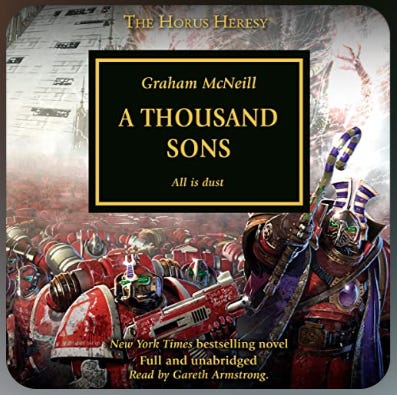
Moving on from Mike Lee’s Fallen Angels, I jumped right into Graham McNeill’s A Thousand Sons as I continue working through the Horus Heresy in audiobook form. I had a lot of hopes for this one; it often comes up on lists of significant reads, and as far as paperback copies go it tends to be one of the pricier books in the Heresy. Certainly, at least, amongst the earlier books in the series.
The Narrator
Gareth Armstrong returned as the narrator for this one, too. With Fallen Angels I found him hit-or-miss, with a very pleasant reading voice and some terrific character work, but with a somewhat limited range:
…whereas some narrators will use accents to differentiate characters, Armstrong instead relies more on pitch and cadence- with much more mixed results. Zahariel and Nemiel in particular often sounded unimposing, at times more like a short-of-breath old man shouting rather than a towering transhuman warrior issuing decisive battlefield commands.
Here, with only one notable exception, he did a fine job. His natural reading voice carried the story well, as it did with Fallen Angels. His Magnus the Red took a little getting used to, as I’m accustomed to Primarchs being a bit more imposing; his was a little more casual here, though I think overall it largely worked. Most of the other Thousand Sons Captains were solid, if sometimes not easily distinguished from one another. But of them all it was his Ahzek Ahriman, Chief Librarian of the Thousand Sons, that fell the shortest.
Ahriman is a big character in the Black Library, himself the subject of a well-regarded five-novel series from John French. If there was a voice that really needed to be a standout performance, it was his. Unfortunately Armstrong used a voice similar to Zahariel and Nemiel in Fallen Angels, and Ahriman sounded almost wimpy in comparison to his brothers as a result.
On the other hand, Armstrong’s voicing of the remembrancer Lemuel Gauman was a standout performance, much as his Luther was in the previous book. It went beyond voice into affectation, with Armstrong truly bringing the character to life. His Gauman stole many of the scenes he featured in, and in so doing he helped drive a lot of the genuine human tragedy present as events hurtled towards their conclusion.
The Story
In talking about McNeill’s work here, it’s important to separate the storylines in terms of scale. On the one hand you have this large-scale, epic narrative of the the fall from grace of the Legion of Magnus the Red. Don’t let the novel’s subtitle (“All is Dust”) fool you, for this story ends before the casting of the Rubric- but there’s still plenty of tragedy in this telling of the Legion’s downfall and the destruction of their beloved homeworld, Prospero.
Then on the small scale, you have the more human element that’s moved forward by a trio of psychically-gifted remembrancers. McNeill employs the same narrative strategy here that he did with Mechanicum to good effect, grounding this larger-than-life tale with characters that are more relatable for the reader. In that book it was Dalia Cythera (and her cohort of transcribes and tech-adepts) that served as a sort of reader stand-in, while here it was Lemuel, Camille Shivani, and Kallista Eris, remembrancers who come to discover that they have more in common with the Thousand Sons than just service to the Emperor.
This part of the story sees McNeill at his best, hitting strong emotional beats with these characters as Prospero’s tragic end approaches.
It’s the other half of the story- the one comprised of the large-scale, epic sweep of events- that let the book down somewhat.
Half Codex, Half Novel
For one thing, this book has a lot of exposition. A lot of it. Now I’m the kind of reader that buys Codexes for the lore so I wasn’t at all disappointed in this. But the infodumps definitely got in the way of the story at times, and the sheer volume of it disrupted the story’s pacing and momentum. It also resulted in a missed opportunity to tell a more emotionally moving story.
It’s not much of a spoiler to note that in the end, the Emperor sics the Space Wolves on Prospero, and the planet is destroyed. Consider the following passage:
Like a stabbing finger of raw light, the first energy lance struck Prospero a kilometre north-east of Tizca. It impacted in the wide ocean bay of the port and flashed a five-hundred metre column of seawater to superheated steam. A series of follow-on blasts seared into existence within seconds, marching vertical striations of incandescent brightness that sent up towering geysers of saltwater.
Banks of scalding fog rolled in from the ocean, boiling the flesh from the bones of early-morning dockworkers. Projectiles streaked through the lower atmosphere on trails of fire as shockwave fists pummeled the sea and sent foaming breakers crashing to shore.
Whole swathes of mountains simply vanished in towering mushroom clouds, magma bombs levelling entire peaks and filling the valleys with rubble. The earth shook with man-made thunder, the relentless pounding of the planet’s surface like pile-driving hammers repeatedly slamming down. In orbit, more and more warships added the weight of their fire to the bombardment, hurling building-sized ordnance towards the planet below. The total saturation of the target area ensured that the city was completely engulfed, enough to level a continent’s worth of metropolises.
Three paragraphs, very tell-over-show. Each of these could have- perhaps should have- been given room to breathe over a few pages. The image of the Tizcan dockworkers getting steam-broiled is tragic and horrible, and would have made for a great passage showing the tremendous suffering and loss of life inexorably closing in to the ordinary citizens of Prospero. This is, after all, the singular tragedy of the story.
To be clear, it’s not that the above passage is bad. Indeed, it’s perfectly serviceable. It’s just that McNeill seems to have missed an opportunity here to make this story sing.
Instead, it just speaks.
Bits n’ Pieces (Spoilers)
Magnus at times reminded me, funnily enough, of Homelander from The Boys. It’s not entirely fair- the Primarch of the Thousand Sons isn’t an out-and-out sociopath, but when he snuffed out Uthizzar for nothing more than knowing too much, it had the same vibe of people being disposable whenever they’re inconvenient. Couldn’t he have just sworn Uthizzar to silence? Used his power to erase the knowledge?
It was interesting the degree to which Magnus paralleled Konrad Curze at the end. Magnus accepted the destruction of Prospero, as fighting back would only confirm the Imperium’s belief in their disloyalty. “Death is nothing,” said Curze as his own assassin approached, “compared to vindication.”
With A Thousand Sons down, up next will be Nemesis by James Swallow as I continue to work through the Heresy, one listen at a time.