
I’ve noted previously that Horus Heresy books tend to fall into one of two categories, and the public perception of them is much more favorable to one of them than the other.
The first one contains books that recount the events of the Horus Heresy. These are the big, grand space-operatic tales of the fall of Horus Lupercal and the civil war that follows. They move the narrative forward with big swings, often featuring highly dramatic scenes with highly dramatic Primarchs. For those wanting the essential story of the Heresy, these are the ones to read.
The other, seemingly less-loved category are stories that take place during the Horus Heresy. The Heresy isn’t the story here, it’s the setting. Yes, there can be Primarchs in them, yes some big events can thread through in some way, but they aren’t the heart and soul of the tragedy.
The first time I noticed this was with 2008’s deeply-unpopular Battle for the Abyss, by Ben Counter. In the online forums where Black Library fans convene, this one is frequently invoked as one of the series’ misses, a story that didn’t have a lot of impact on the events of the Heresy and felt like a letdown.
As only the eighth novel in the mainline series, I can see why many found it a letdown given how self-contained the story is. The preceding novels kicked off this massive, world-shaping series, and here you had what was in essence a side-story 30K version of Tom Clancy’s The Hunt for Red October. Series editor Laurie Goulding, writing in the afterword of the 2016 hardcover reissue of the book, addressed this head-on.
Battle for the Abyss was a book very much of its time. As the Horus Heresy was growing and evolving through the novels, the time scale for everything was in flux, and when Ben started writing there were no plans for anyone to write novels specifically dealing with the battles of Calth or Prospero… Ben was forging new ground, like unto a pen-wielding pioneer of the Word himself.
Many of those early books have that exciting feel to them. In the first ten volumes of the Horus Heresy, there were no stars to steer by, no maps to follow.
Only once we began to have authors referencing other extant plotlines within the series did the links between the many books start to become apparent. This wasn’t just a setting – it was a single and incredibly complex story, the full extent of which no one contributor could see until their own work was finished. You think you were confused by whose side the Alpha Legion are on, or whether each of their twin primarchs actually knows what the other is doing? Try being the series editor...
Dan Abnett’s Legion was the next time I noticed that in some ways, I found myself preferring some of the stories in that latter category. The big, splashy ones were a lot of fun, but the Heresy itself was an incredible time of upheaval, and seeing how that played out on a smaller scale could be just as fascinating1. This explains my love of Nemesis, James Swallow’s delightful Cold War-cum-30K assassination spy thriller (reviewed as part of this series here).
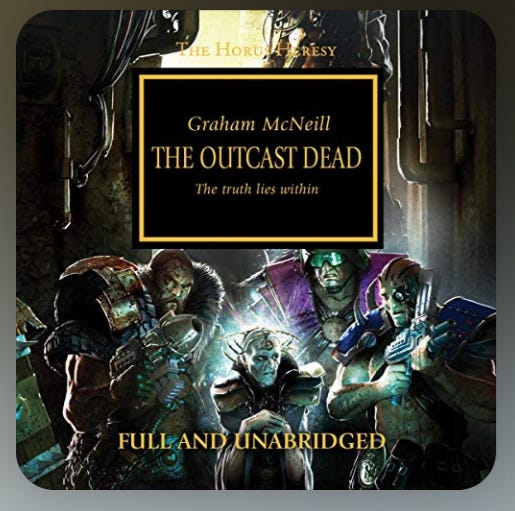
The Outcast Dead is the most recent inductee into this camp as I make my way through the Heresy, and once again I found myself really enjoying both the story and the exceptional narration of Jonathan Keeble.
The Story
Graham McNeill’s tale gives us a side of Warhammer that we very rarely see: the workings of the Astra Telepathica. In The Outcast Dead we meet Kai Zulane, a tremendously gifted astropath whose mind has been broken by terrible tragedy. Stationed as ship’s telepath on the Argo, an Ultramarines vessel, the ship’s warp-shielding Gellar field gives out, opening the vessel to a flood of ravenous daemons. With Zulane being one of only two survivors, he is sent back to Terra to recover.
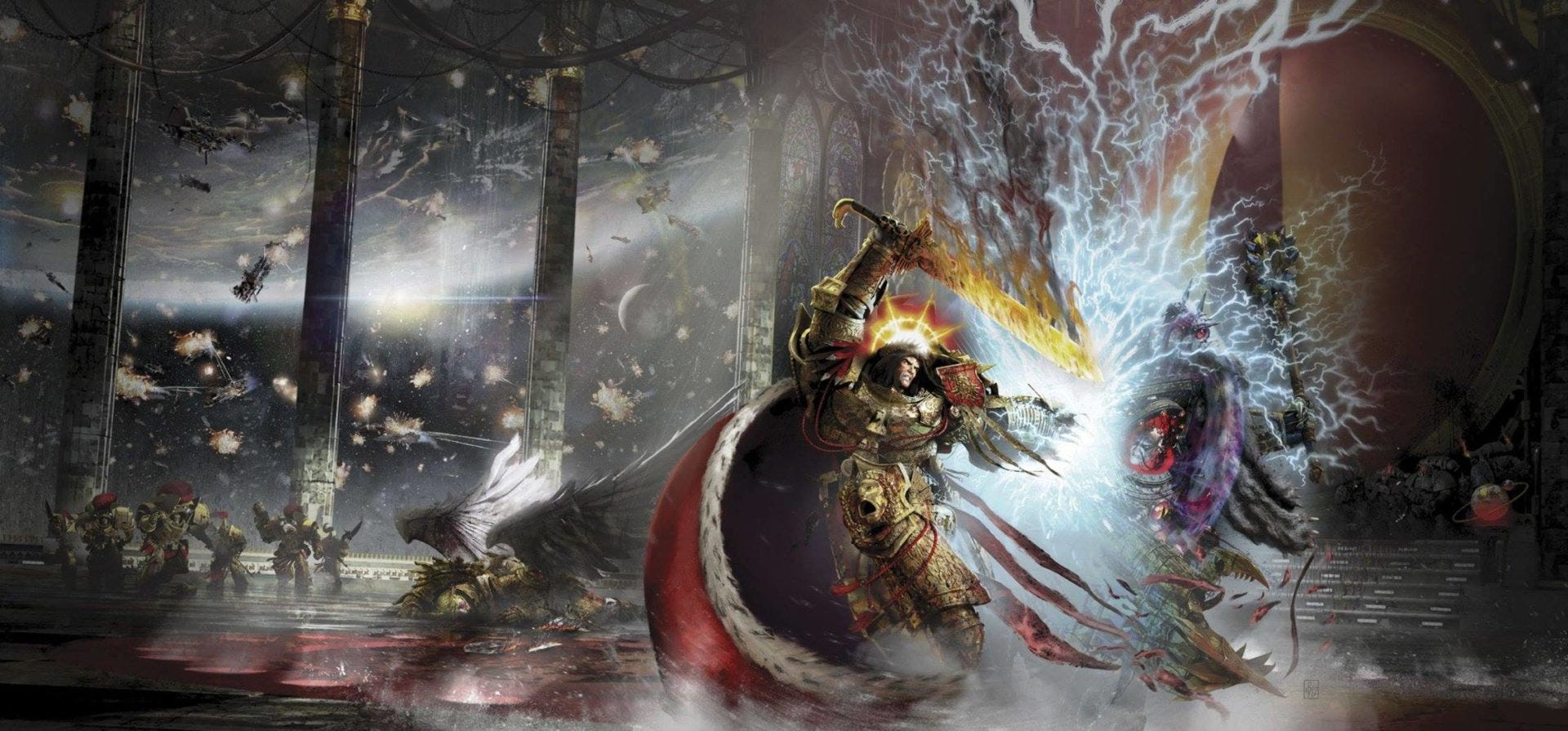
While there, the psychic peace is shattered when Magnus the Red, Primarch of the Thousand Sons, uses his psychic power to appear before the Emperor and warn him of Horus’s treachery. While well-intentioned, the reverberations from Magnus’s sorcery are seismic, sending a shockwave of psychic energy that ripples across the Imperial Palace and beyond. Kai unwittingly receives a vision of the future, a glimpse of the future of humanity following the end of the Horus Heresy.
This secret lands him in the heart of a tug-of-war of intrigue and violence. On one side are his Imperial handlers, ready to psychically vivisect his mind in order to unlock the secret that Kai knows is there but cannot see. On the other are the ‘Outcast Dead,’ a band of Astartes from the Traitor Legions that were part of an honor guard on Terra- until their Primarchs rebelled. Thrown into a high-security prison, they manage to break out and seek to rejoin their Legions, and if they can do so with a telepath who holds the secret to the end of the war so much the better.
The Dead- led by Atharva of the Thousand Sons who orchestrated the escape- manage to secure Kai and go to ground in the slums surrounding the Palace. Now an Imperial kill team fronted by a Seer Hunter of the Black Ships, Yasu Nagasena, must track down the renegades to get to Kai before they manage to find passage offworld.
Telling the Tale
This is McNeill’s fifth novel in the Horus Heresy, and combined with his terrific work in Mechanicum it really crystallized how adept he can be at building characters. In both books you have a collection of people that are very different from one another, bringing them together in service to a vital task that gives each of them opportunity to memorably develop.
In Mechanicum that was Dalia Cythera, the Terran transcriber with an affinity for machinery. Tasked by Adept Koriel Zeth of Mars, she joins a team that includes machinist Zouche Chahaya, assembler Caxton Torgau, and others to build an esoteric device from incomplete schematics. Brought to life by Jonathan Keeble’s terrific vocal range, the dialogue, chemistry, and depth of the sequences with Dalia’s team are the very heartbeat of the book.
I had a very similar feeling towards the band of renegades known as the Outcast Dead here. A trio of World Eaters alongside a Death Guard, Luna Wolf, and Emperor’s Children, their sequences were remarkably moving. There’s one scene were, just after they manage to escape from imprisonment, they’re all sitting around a fire wondering what they will do next, or even what they should do next. They had no idea, after all, about the events of the Horus Heresy until they were taken into custody for no reason other than their Legion affiliation. Caught between loyalty to the Emperor and to their brothers and Primarchs, it’s hard not to feel for them here.
When the central event of the setting focuses so much on the military events that comprise it- particularly easy to do considering it’s build on a tabletop wargame- it’s not hard to lose sight of just how momentous this event would have been to the countless souls that make up the Imperium. That’s why stories like James Swallow’s Liar’s Due (included in the Era of Darkness anthology, covered here) are able to mine some of the richest narrative veins in all of Warhammer.
It’s for that reason perhaps that I find these “skippable” books in the Heresy every bit as riveting as the others. Here’s McNeill from the book’s afterword, discussing what attracted him to the setting to write a story like this one:
This was also a chance to witness the darker side of Terra, a place we’d only seen in snapshot. As we followed the travails of the Outcast Dead, I had a chance to explore the underbelly of Terra’s dream, to see the first hints of the nightmarishly bleak world the birthrock of mankind would become in the 41st millennium.
The military stories are terrific, but yes- more of this too, please.
Editor Wanted
One impression that lingered throughout the entirely of The Outcast Dead was that McNeill’s editing team may have let him down a bit here. Nothing quite so grievous as lore breaches or dropped plot threads, mind, but I was taken aback by the sheer volume of duplicated word usage that occurred throughout. A few here or there isn’t anything unusual or problematic, but it’s when they’re so frequent that they distract from immersion in the story that’s something that should be addressed before a manuscript is advanced to print. A few examples:
The skimmer glided to a halt and the batwing doors hissed as they swooped up with a hiss of high-end pneumatics.
Their mouths were stretched in skeletal grins, and that same dead light burned between their burned lips as though they were screaming light.
The adept vanished, and the tide of darkness that billowed and seethed like a living curtain of endless darkness spilled over the top of the dune,
Diving forward he rolled to his feet and another shot punched a warrior armoured in mirror-black armour from his feet.
Groups of mourners gathered in sombre groups on wooden benches,
It took a moment for him to realise the significance of the moment,
The warrior’s aura blazed with anger, the swirling colours of angry bruises and hot, pumping blood.
Its screaming was never ending, but its form was little more than a scrap of dirty, yellowed light as its power was stripped away. Soon, even that was gone, and its keening lament came to an end as the power that sustained it was stripped away.
Well, you get the idea. This isn’t something I’ve particularly noticed in previous books by McNeill, which means either this was particular to writing this one or that perhaps it’s one of his writer’s foibles that usually is wrinkled out on the editor’s desk.
Again, not enough to derail my enjoyment, but one of those things that once you start noticing a few, you can’t help but notice the rest.
Bits n’ Pieces (Spoilers)
This is the perfect book for Jonathan Keeble to narrate, and one that would have suffered, I think, under some of the other narrators I’ve enjoyed. The greater the range of voices a narrator can develop, the more distinctive they can make the characters in a story. I’ve noted that narrators like Gareth Armstrong have terrific voices but more restricted ranges, and would have suffered somewhat in a book with a cast as broad as this one.
At the time I’m writing this, there was an interesting discussion in the community on the tension between going into a story fresh versus having some things spoiled by watching lore videos. “Go in cold,” I noted, “you get it all as new but may miss things. Go in prepped, it’s less surprising but you’ll see more things. There’s no ‘wrong’ answer, so if you just do what you’re enjoying you’ll be minted either way.” This one’s a great example of that, as one of the Outcast Dead (Severian, the Luna Wolf, the only one who appears to survive at the end) apparently has a larger part to play2.
One of the book’s real treats is the presence of Thunder Warriors. McNeill does a good job concealing their true nature until later in the story, and this is another example of something you might miss by ‘going in cold.’ The Thunder Warriors were essentially proto-Astartes, the Emperor’s earlier attempt at making genetic super-soldiers, and it was generally accepted that they’d been wiped out much earlier in the lore. McNeill not only introduces a couple of them here, giving them significant presence as secondary villains, but he also ends the book on a bit of a cliffhanger with them. I have no idea if that thread ever gets picked up in subsequent stories, but I’ll definitely be keen to see if it does.
It’ll be awhile before we see another Heresy novel from McNeill, with Angel Exterminatus being the 23rd in the series. But I found this one great listening, and don’t hesitate to recommend it.
Legion’s a funny example, because ultimately it’s not quite as small-scale as it appears. But a lot of the significance of what that book reveals doesn’t come into full bloom until later.
I went in cold, as I often prefer to do, so his significance didn’t occur to me until the ads in the ending pages of the book promised, “Severian’s story continues in Wolf Hunt. The former Luna Wolf leads his pursuer on a deadly chase through the shadows of the Petitioner’s City.”
I’ve noticed the word duplication in other books too. Enough that I started to wonder if it was deliberate or at least not considered undesirable. I can’t remember if it was McNeill or a different BL author though.