
If you’re anything like me, with the bulk of my tabletop wargaming interest being occupied by the Warhammer properties of Games Workshop, the way that Factory Fortress has structured Trench Crusade can appear a little Byzantine.
That’s because unlike Warhammer, where their model range is entirely proprietary and produced in-house, Factory Fortress launched Trench Crusade as explicitly model-agnostic. This means that there’s plenty of smaller design studios producing miniatures that are “compatible” with Trench Crusade, which is really a shorthanded way of saying that they either made the sculpts with the game in mind, or that they are pre-existing sculpts that are an acceptable thematic fit for the property.
To add another layer on top of that, Factory Fortress has partnered with two other companies to produce a range of officially-supported minis. In other words, though another company is producing them they are considered an official faction and have their rules and lore content either written or approved by Factory Fortress.
From a hobbyist’s perspective, this quasi- “open source” structuring allows the public to feel like it’s a stakeholder with a seat at the table. Aside from a few mechanical-facing considerations like base size and model scale (for line-of-sight), this liberty has allowed players to entertain their vision of the world with a surprising amount of customizability.
Want to build a Heretic Naval Raider warband out of LEGOs? The world is your oyster, friend!
And from a business perspective, these were canny steps that gave the property an opportunity to establish a footprint that punches well above its early-stage weight. Proprietary-only game lines can bottleneck on the initial production ramp-up, since that sweet, sweet starting capital only goes so far. Opening the game up as model-agnostic is a great way to build an early player base in an already relatively crowded wargaming field; opening up design and production of official factions to third-party partners is a great way to get a larger base of game components to the table in a comparatively shorter amount of time.

Shaping the Brigade
Enter Montreal-based Westfalia Miniatures. Founded in 2007 by Kawe Weissi-Zadeh, it was one of two companies that partnered with Fortress Factory to develop an official faction range for Trench Crusade. Westfalia- which also produces miniatures for historical wargaming as well as games like Mörk Borg- was a natural partner for Factory Fortress given their artisanal ethos, gritty aesthetic, and industry reputation.
Plus, they have a guinea pig on staff.
When the Trench Crusade Kickstarter campaign kicked off in Autumn of 2024, an announcement for The Red Brigade was not far behind. From their rules PDF,
“The Red Brigade is made of volunteers who have lost someone close to them in the battles of the Great War. The unit was founded by St. Ernest, the sole survivor of the second battle of Acre; where he lost his brother Wilhelm to the forces of the Heresiarch B Berenguer.
“Red Brigade are a grim and silent unit, haunted by their losses and long patrols in enemy territory. Often yearning to be reunited with their lost ones; they are willing to accept missions where death is almost certain. This self-destructive attitude chafes ma many members of the clergy, who do not condone the existence of the unit; as suicide is a mortal sin. However, the Brigade has proven itself to be so useful to the Duke that the red-armoured troops have seen continuous service for decades.”
A subfaction of New Antioch, the lore was developed through a collaboration between Westfalia’s Weissi-Zadeh and Trench Crusade co-creator Tuomas Pirinen, with Pirinen also contributing their rules design for the game itself. Lead Artist Max Maurel contributed the sculpts, and altogether the Red Brigade’s early 2025 crowdfunding campaign was a tremendous success.
What’s in the Box?
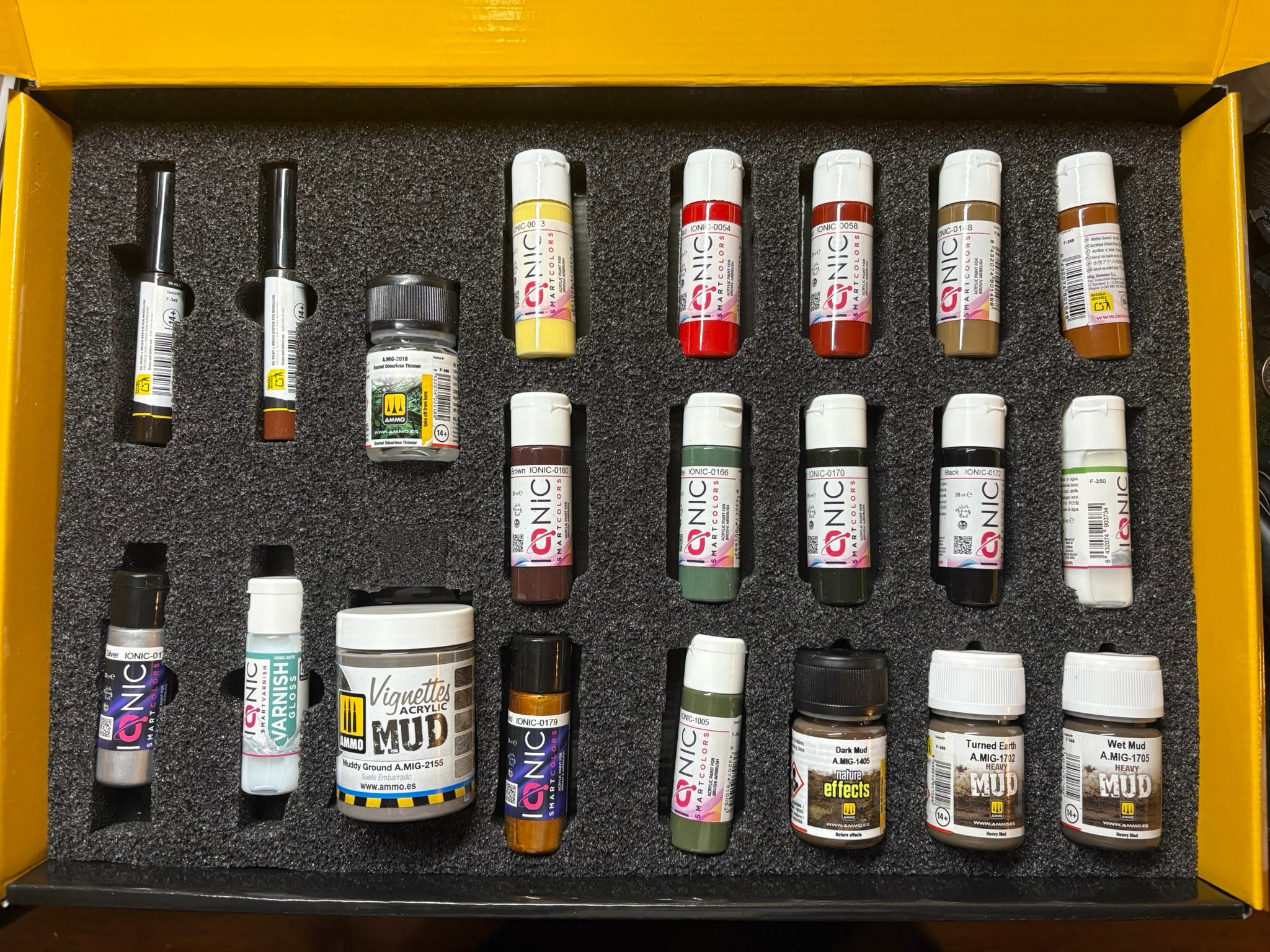
Last month, Westfalia’s Red Brigade was back in the spotlight as the subject of a limited-edition collaboration between Westfalia, hobby paint and weathering company AMMO by Mig, and Factory Fortress. The How to Paint the Red Brigade Solution Box not only offered up a collection of paints and weathering effects, but also included a How to Paint guide penned by Rubén Torregrosa (HeresyBrush) as well as an STL file for a Red Brigade Mechanized Gunslinger.
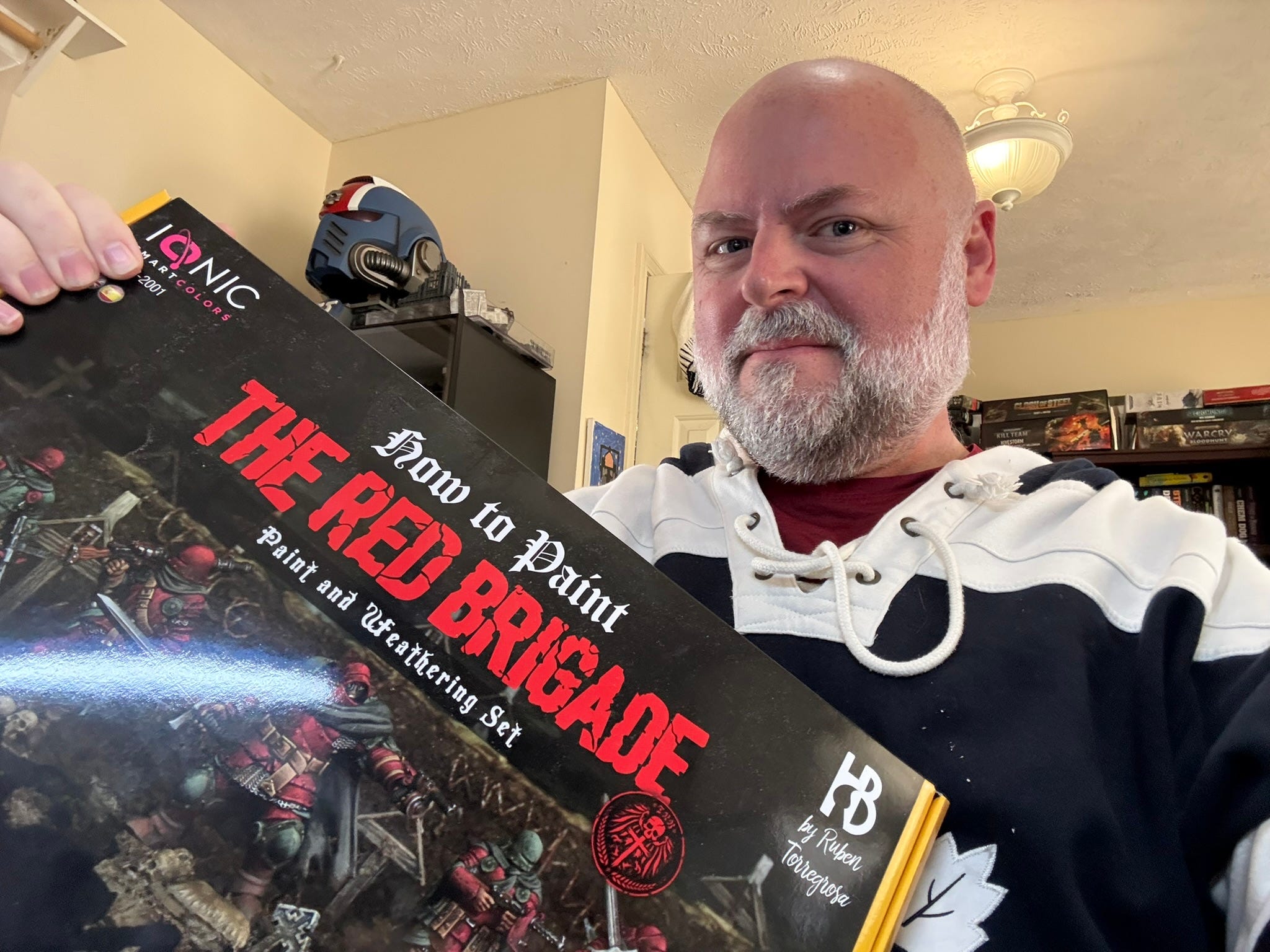
I’ve not been shy about sharing that of all the ways I interact with this hobby, painting is not one of them. Since it’s an area I’m keen to try, this Solutions Box seemed like an ideal way to dip my toe in, especially because of the inclusion of Torregrosa’s How to Paint guide. It’s from that novice’s perspective that I’ll be giving the product an overview today.
Torregrosa’s beginner-friendly style had first caught my eye with his piece “Bringing an Observer to Life,” which had featured on the official site in The Trench Wire in mid-October. Despite not being a painter myself, I find his instructions very clear and simple to follow, with the sorts of explanations a veteran might gloss over but prove invaluable for those seeking not just the how and what, but also the why. For example, here he is talking about glazing, and even if you’ve never picked up a paintbrush in your life you’ll walk away from this with a greater understanding than when you found it:
“The behaviour of the glaze depends largely on the brushstroke. As we move the brush across the surface, more pigment is deposited at the point where the stroke ends. We can use this to our advantage. When reinforcing shadows, we begin the stroke in the mid tone area and gently pull the brush toward the deepest recess. In doing so, the highest concentration of pigment settles exactly where we need it, naturally intensifying the shadow while preserving smooth transitions.”
With the collection of paints and other accessories stickering for just under USD $100, that meant that I was getting the fully-illustrated painting guide and Mechanized Gunslinger STL for about twelve bucks. And if it helped me break down the barrier to the world of painting, it would be money well spent.
Training Manual
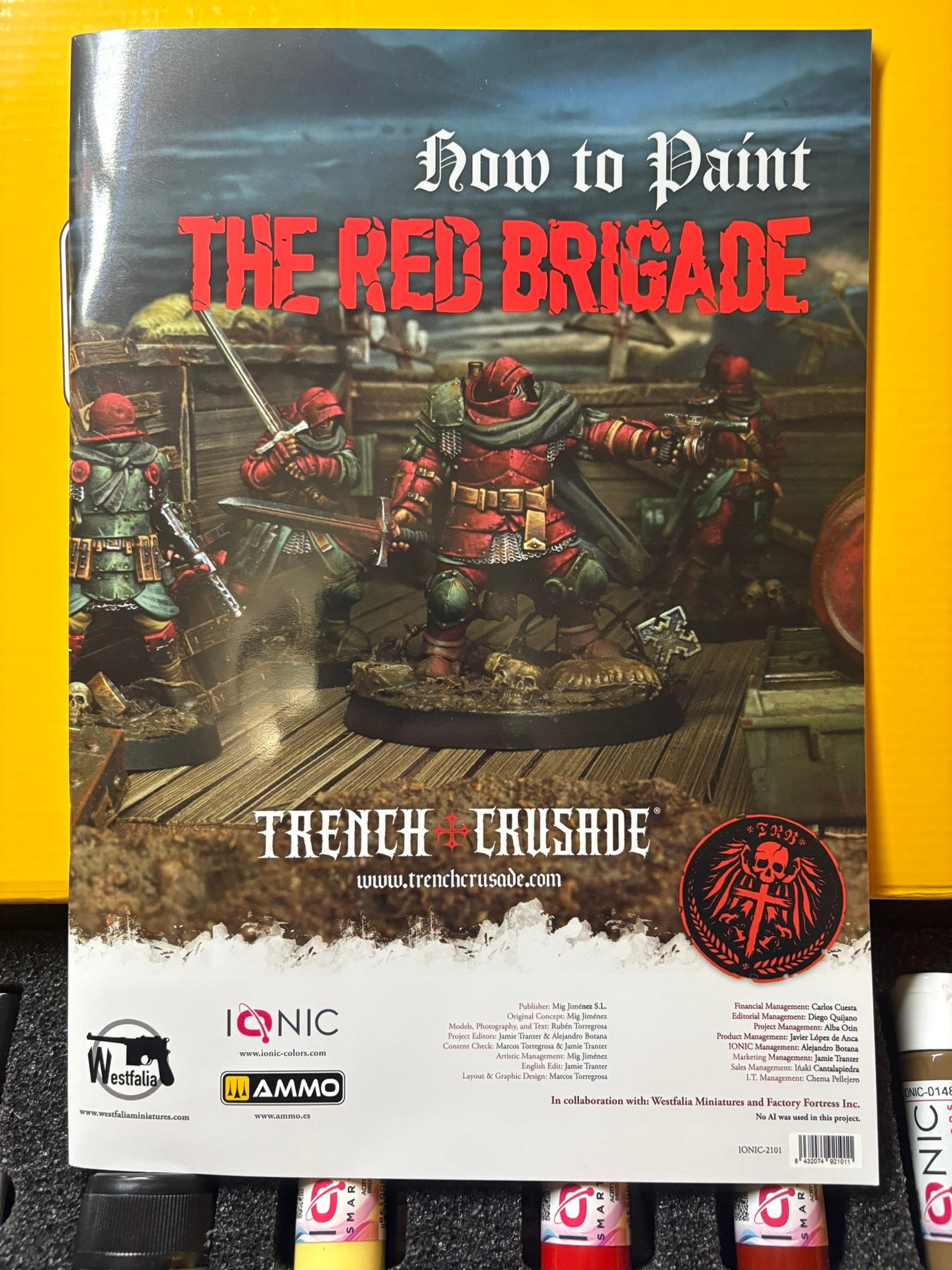
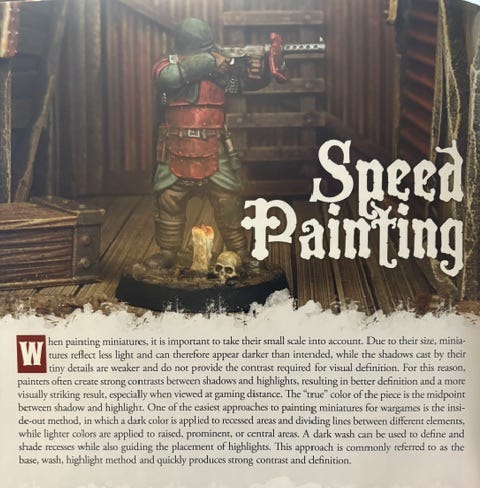
The first thing I noticed was the quality of the training guide itself. It’s 36 full-size pages, split (nearly) down the middle between the English and Spanish halves. It has a glossy, thicker stock to the cover, and visually strikes a terrific balance between highly-detailed photos and step-by-step written instructions.
Torregrosa chose two different models for his tutorial, a Combat Engineer and the included Mechanized Gunslinger. And while I’d have been quite happy with a fairly detailed walkthrough just on how to do a standard version of each, clearly he had a better approach in mind.
“Many wargamers favor efficient techniques that allow them to get their miniatures onto the tabletop quickly. Others, however, enjoy painting as much as, or even more than, gaming and are happy to spend extra time at the painting desk.
“This guide has been designed with both approaches in mind and includes two step-by-step tutorials: one designed for faster, more efficient results, and the other focused on a more advanced and time-consuming method that produces a more elaborate finish.”
As a onetime friendly, local game store owner, onramps to a hobby were always one of the things I paid closest attention to. If someone new came in and said they wanted to learn Magic: the Gathering, for instance, it was crucial to be able to have something to provide them that introduction beyond “just figure it out,” or, “come in and someone will show you.”
At the same time, the danger with a product that leans too far into the onramp aspect (unless it is specifically designated for the novice) is that it may lose its appeal for the more established hobbyist. Who wants to grind through a ton of 101-level content just to get to a few useful bits?
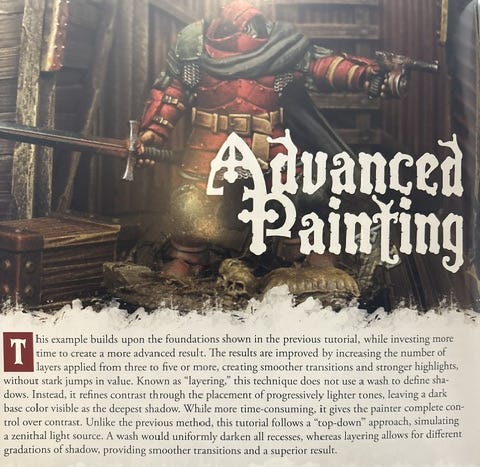
How to Paint The Red Brigade appears to split this difference nicely. It’s not a full-bore introductory tutorial; you’ll want to have some idea of how to paint in order to get the most from the guide. After all, Torregrosa only has about eighteen pages to work with, and a completely starter-focused offering could easily exceed that allotment all on its own. But even with my wafer-thin painting resume (two “paint and takes” at my local Warhammer store), I felt very comfortable reading through the steps.
One thing I particularly appreciated was the guide’s precision. As they say, there’s no wrong way to paint a model, as each hobbyist is free to bring their own creative flair into the mix (you can find some great examples of that here). But when you’re just getting into the hobby- or if you deliberately want to paint a “standardized” scheme- having very specific instructions helps you find your footing1. Torregrosa regularly offers measurements rather than generalities, such as “dilute with 70% water” or “leave approximately 20% of the previous layer visible.” Amateur chefs too will also know how reassuring this is, to see “1/4 cup” instead of “add flour until it thickens”.
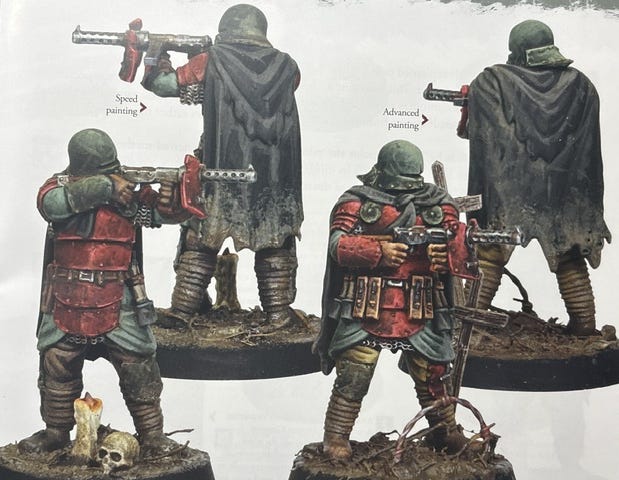
Overall, the guide covers painting, weathering, and basing, and I’m already looking forward to using it as the basis for my foray into painting Trench Crusade. Now I just need to order up some Red Brigade miniatures (and secure a print of the included STL), and I’ll be off to the races!
While I naturally must reserve any final judgment for the future when I’ve had a chance to crack things open and begin the experience, my initial impression is that this is a very good value for dollar. I have little cause to doubt the quality of the included supplies, and the many examples in the guide using them look terrific. The guide itself is the star of the show, detailed and insightful enough to be useful for a variety of skill levels but welcoming enough for all but the most rank novices to learn from.
It’s well worth checking out, and I’m hoping to see more of these kinds of things in the future.
Seriously, nothing triggers my lack of confidence and analysis paralysis more than when instructions appear to ask me to ‘wing it’ or rely on judgment I don’t feel I yet have. “How big- exactly- is a ‘daub’?”