
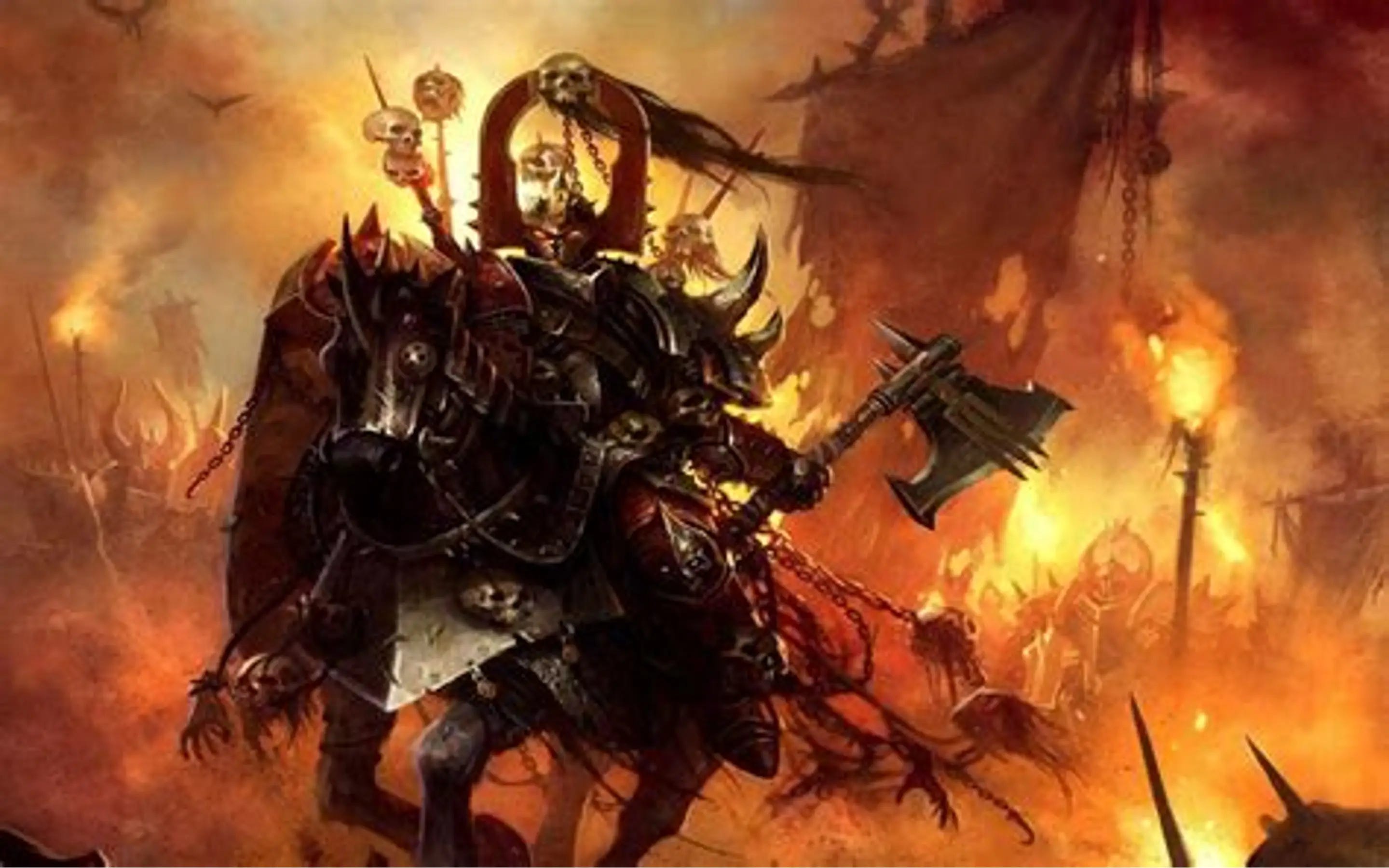
The Hall Monitor is published every other week, the same day as the latest installment of the Black Library Readers’ Hall of Fame drops on Tabletop Battles. A cross between a director’s cut and a backstage pass, it’s a look behind the scenes at the Hall of Fame project.
Subscribers note: You are receiving this email since you’re subscribed to the Black Library Features segment of the Warhammer Wordforge. You can easily update your subscription and notification preferences at any time (see here). Thanks for your support!
Somewhere around 2011 or 2012, Games Workshop appears to have made the painful and difficult decision to kill off Warhammer Fantasy Battles1. The fans wouldn’t know this for a few years yet, but the property was a dead man walking.
When looking to understand why GW would kill off a storied property that had enjoyed three decades of lore, story, and development, there are three major factors to consider.
The Financial
By the time you saw the game’s 8th Edition in 2010, its most prosperous days were well behind it. It’s often cited that a Space Marine Tactical Squad box by itself was outselling the entire Warhammer Fantasy Battles product range, and whether that’s true or not it certainly hits at a financial reality for the game: it just wasn’t making money.
There’s a number of reasons for this- as with any property consumer interest comes and consumer interest goes depending on all sorts of factors both internal and external. But it didn’t help that the barrier to entry for the game was quite high. Building a playable army required a substantial investment, while your most mature consumer base- who already had their preferred armies bought- weren’t incentivized to continue their purchasing2.
Games that don’t make money do not stay games forever.
The Legal
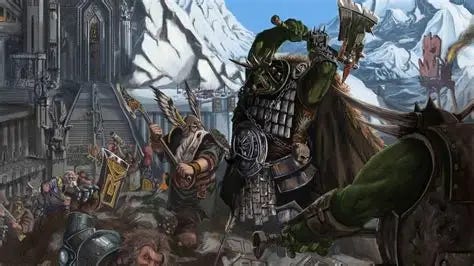
In 2010, Games Workshop sued a Texas-based company called Chapterhouse Studios over copyright and trademark infringement. Chapterhouse had existed on the margins of Warhammer; it wasn’t so much creating counterfeit miniatures as selling miniatures accessories (heads, shoulder pads, weapons, etc.) for players to customize their Warhammer models.
Chapterhouse fought back, using the defense that they were in the aftermarket business selling non-infringing accessories that were simply “compatible with” Warhammer figures. After a bruising three-year trial, the jury ruled in favor of Games Workshop- but only just. Damages were reduced down to $25,000, and GW left to learn some painful hard truths about their market position.
For one thing, the entire affair revealed just how exposed their IP was. Orcs, Elves, Space Marines, Imperial Guard… far too many of Warhammer’s core factions were based upon concepts that were firmly in the public domain, and therefore could not be trademarked. Now Orruks, Aeldari, Drukhari, Adeptus Astartes, or Astra Militarum… now those are substantially more enforceable.
Given how much of Warhammer Fantasy’s IP was based on a blend standard, Tolkien-esque tropes and Renaissance Europe, however, the writing was almost certainly on the wall. What looked rich and deep to us fans on the inside looked generic and unprotectable in a court of law.
The Narrative
Warhammer Fantasy- based as it was on European history with a seasoning of fantasy- did not have a lot of narrative agility. By having everything tightly locked on a map you had to do a lot of lorework if you wanted to introduce, say, a new faction, or shake things up politically. Sure 40K had a “map” of the galaxy, but its immense size meant that you could stage just about anything anywhere and not bump into anything around it.
The flexibility of settings like AD&D’s Planescape (released in 1994) was surely not lost on Games Workshop, with the “planar model” meaning things could be added and subtracted almost at will with minimal disruption to the rest of the setting.
Ripping the Bandaid Off
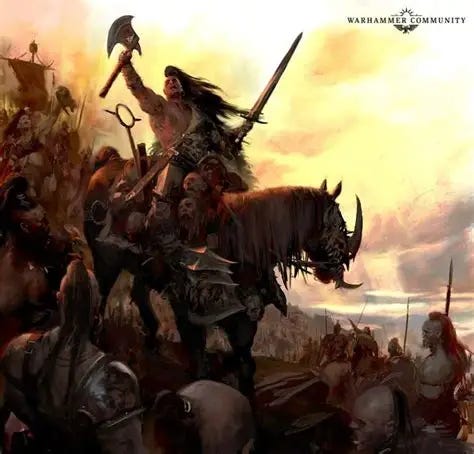
The transition from Warhammer Fantasy to the Age of Sigmar presented Games Workshop with a problem- but also an opportunity. The problem they keenly wanted to avoid was having too long a lead time between the demise of one franchise and the birth of its replacement. After all, gamers tend not to sit still, and if the market was allowed to move on from WFB while Games Workshop worked on its replacement, they’d find no small portion of the market no longer there when Age of Sigmar launched.
This required a fair bit of behind-the-scenes coordination, with development of the Age of Sigmar property going full tilt behind the scenes while Warhammer Fantasy began its sunset. Narratively, this found its fruition in The End Times, a story-based detonation of the entire property woven through both the tabletop as well as the fiction of the Black Library.
I was never into Warhammer Fantasy; my introduction to 40K came at around this time so I was busy with Eisenhorn, Cain, and Gaunt while the likes of Karl Franz, Thorgrim Grudgebearer, and Vlad von Carstein faded into history. But as I’ve been walking through the hallways of that history thanks to the Black Library Readers Hall of Fame project, it’s been difficult to escape a sense of the maudlin while through its echoes.
This world- these characters- were beloved once.
The End Times was a commercial success for the Black Library, though hardly one without a great deal of controversy and upheaval- not least due to its feeling very compressed and arbitrary. With pallets of Age of Sigmar plastic waiting in the wings, the clock was ticking to wind one world down so that another might be born.
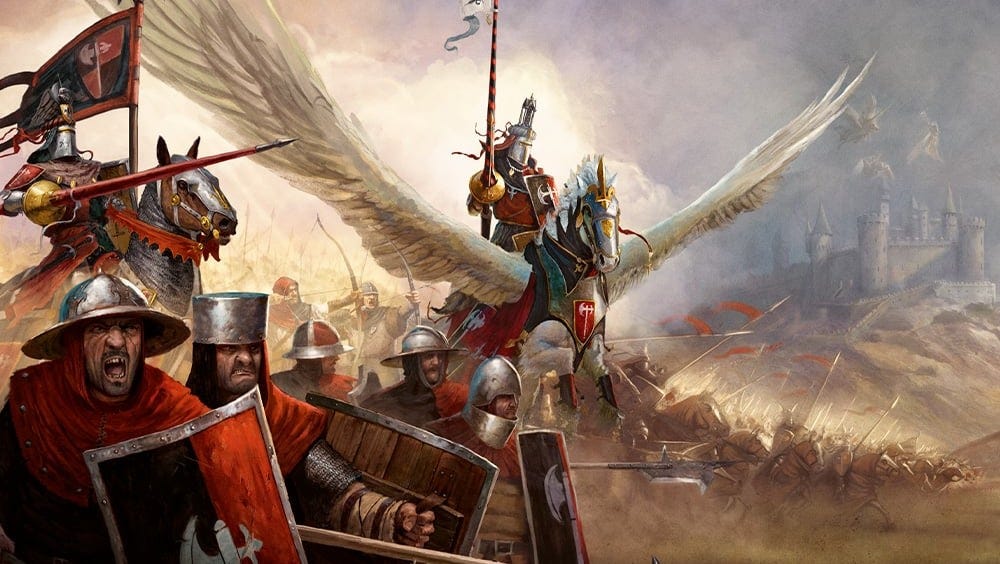
It’s been heartening to see that denouement being well-recognized in the Hall as well. There were more fantasy titles inducted this week than any other property, which might well be a first for the Hall. It may be going out, but it’s not going out with a whimper.
Exactly how it should be.
The Vox Populi Top Twenties
So here are the updated Top Twenties for both halves of the Black Library, but first a look at the updated Leaderboard:
Hall Winners Leaderboard
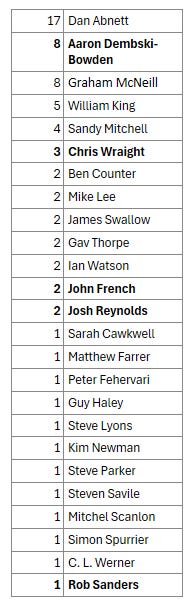
Exciting news for Rob Sanders, of course, as he gets his name amongst what remains very select company indeed. A second for John French and Josh Reynolds, Chris Wraight jumps up a bit, while Aaron Dembski-Bowden draws level with Graham McNeill towards the top of the table.
What’s particularly notable here is that Wraight landed two Hall of Fame books in 2014. Bartender, I’ll have what he’s having, please…
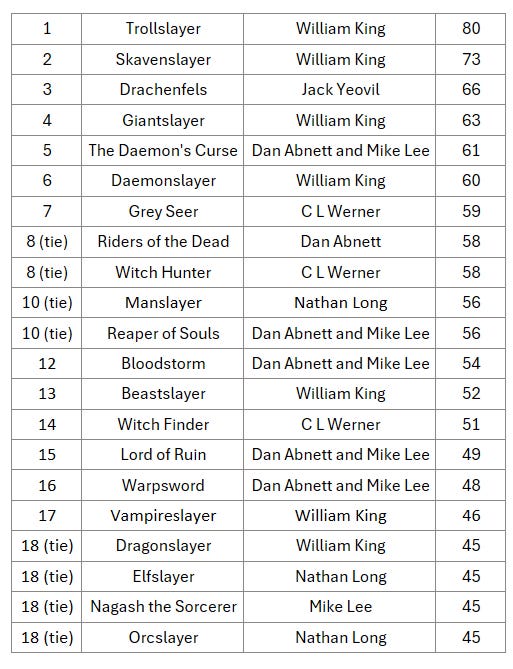
Fantasy
30K/40K
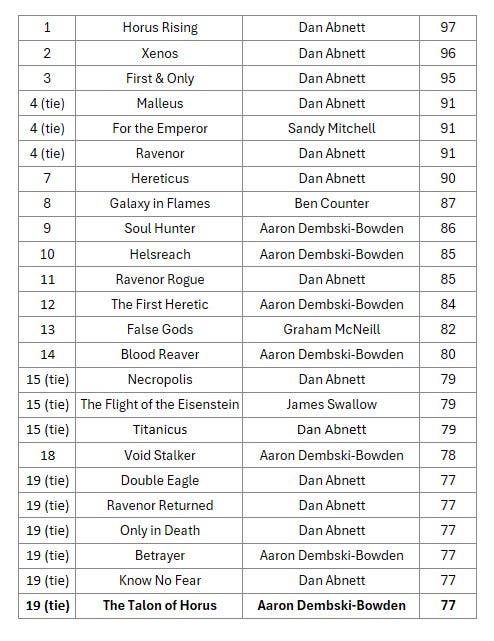
Not a lot of movement in the Top Twenties, but this far along in the project that’s probably to be expected. I think the days of extraordinary unity as seen with books like Horus Rising and For the Emperor are likely behind us, but it’s fun guessing which books have the best shot at landing here in the upper 70’s and 80’s.
That’s all for this time, thanks for reading!
We don’t know this with certainty, of course, but rather working our way back from what we understand about miniature design and production lead times. This is an industry that steers like an oil tanker, not a cigarette boat.
There’s a fascinating contrast here with Magic: the Gathering, which early on figured out how to incentivize players to climb aboard a hamster-wheel of consumerism by implementing a regularly-cycling legal card pool for competitive play.