
The Hall Monitor is published every other week, the same day as the latest installment of the Black Library Readers’ Hall of Fame drops on Tabletop Battles. A cross between a director’s cut and a backstage pass, it’s a look behind the scenes at the Hall of Fame project.
Subscribers note: You are receiving this email since you’re subscribed to the Black Library Features segment of the Warhammer Wordforge. You can easily update your subscription and notification preferences at any time (see here). Thanks for your support!
This week, I’m dedicating The Hall Monitor to the mighty leaderboard. “What are the best books?” is a perpetual subject of conversation around Black Library community watercoolers, and the entire Black Library Readers’ Hall of Fame project itself came about in part as a way to try and definitively answer that question.
But of course, that’s not the only way we can examine it. Another metric I’ve had fun keeping an eye on is the voting data from all of the polling we’ve done over the course of the Hall. Just as in boxing, a unanimous decision and a split decision may mean something to some folks, but in the end a win’s a win- so too is it with the Hall. If a book gets enough votes between the reading public and Hall of Fame Committee, they’re in regardless of whether they got 60% of the votes or 90% of them.
But it’s also fun to see just how positively the voting public has responded to a particular book’s candidacy, and I’ve used that metric- the percentage of public voters voting in favor of induction for a particular book- to populate the leaderboards I’ve shared with everyone here in this companion series.
Today, we’re gonna double down on that- go all in on the fun- but first, a word from our sponsor.
Since the start of the Warhammer Wordforge, I’ve tried to be very conscientious about how you, the reader, experience this site when it comes to subscriptions and notifications.
One thing I’ve tried to avoid is having multiple emails go out on the same day. Yes, I’ve set up the site’s categories to make that more customizable for the reader, so those here for RPG updates (for instance) can opt out of Black Library content, but for those who enjoy everything the site has to offer it can still be a bit much.
As a result, starting today The Hall Monitor- a relatively niche companion piece to a mainline series on a completely different site (though written by me on both)- will not be delivered via email. Don’t worry- it’s not going anywhere, I’ll still be running it every other week throughout the duration of the Black Library Readers’ Hall of Fame project.
But with Saturdays now hosting regular installments of Trench Crusade Weekly, I’d like to keep outgoing traffic to your inboxes as modest as I can. This series will still be here as always, but it will be one less potential email cluttering up your notifications.
Now, back to our regularly-scheduled program!
What’s new this week is that I’ve broken out the leaderboards. Previously, we just had one side for fantasy and the other for 30K/40K, but it’s been increasingly clear- particularly on the fantasy side of things- that some books are getting ‘shaded out.’
Sure it’s interesting to know what the “Top 20 fantasy books” are, but with no Age of Sigmar title able to crack the list it seems the old fantasy books have a bit of a stranglehold on it. Putting them in their own categories offers a bit more nuance in examining how books are performing- and also reveals some interesting insights about popularity and readership.
As a final reminder, these tables represent a ranking by percentage of public voters backing a book’s inclusion into the Hall. That doesn’t mean all of them made it in- many did not- but it still gives a useful indicator of relative popularity.
So let’s start with the Horus Heresy:
The Horus Heresy
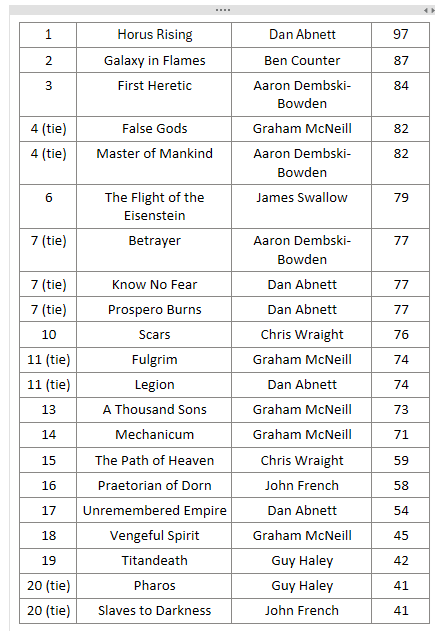
Little surprise that Dan Abnett and Aaron Dembski-Bowden have the strong showing here we’ve seen in the past, but opening the table up to more Horus Heresy books that would have been knocked off by mainline 40K stories presents a much more interesting picture. Graham McNeill, in particular, comes out strong here- not as flashy, perhaps, as the other two gentlemen at the top of the table, but a consistently strong presence in the canon.
What I found particularly interesting here is the lack of books with an ‘approval rating’ in the 60’s. We go right from The Path of Heaven at 59% to Mechanicum at 71%. Not concerning, but simply curious.
Warhammer 40,000
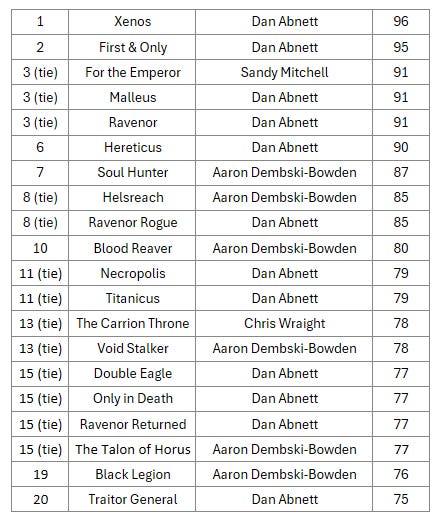
Last time we updated the table (for the books of 2017), the cutoff approval rate to make the Top Twenty was 78%. This is clearly the most competitive field, with the new cutoff only dropping to 75%.
This table really demonstrates the dominance of Abnett and Dembski-Bowden. Outside of two books (For the Emperor by Sandy Mitchell, and Chris Wraight’s The Carrion Throne) 40K is theirs at the top.
Warhammer Fantasy
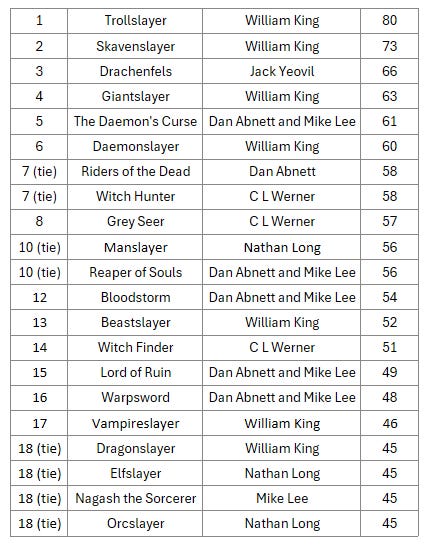
Since Warhammer Fantasy already owned the fantasy side of things before, there are no changes here. And unless they release an Old World novel that charts highly, this one’s likely fully baked.
It’s a great list of some amazing stories, though, and I’d always recommend a visit for those wanting to see what the ‘world that was’ was like.
Age of Sigmar
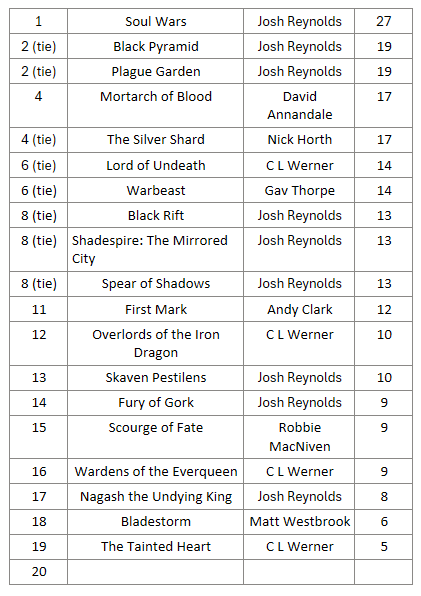
That lack of a 20th book is not a typo, but just a result of not (yet) having twenty books in the Age of Sigmar line to rank. This one will have the most volatility for the remainder of the project, since there’s lots of room to grow here. Books with a single-digit approval rating today will be tomorrow’s casualties as Age of Sigmar fiction continues to expand.
That leads me to the second thing that’s interesting here. Those approval ratings are low across the board- Soul Wars is the undisputed king of the hill, here, with just 27%. That’s about half of what the lowest-rated Fantasy book scored in the Fantasy Top Twenty.
What gives?
A closer look tells the tale. Here’s how Soul Wars looked in the polling:
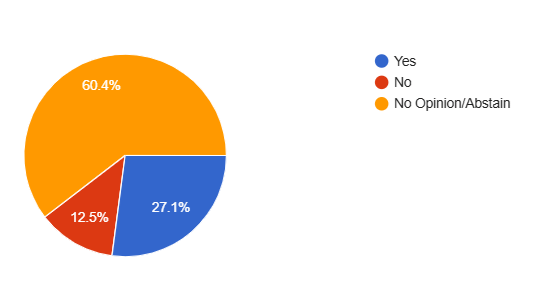
With just a 12.5% vote against induction, Soul Wars actually did quite well in polling… but the overwhelming majority of readers simply had no opinion of it.
This is the biggest driver of why the Fantasy books scored so much lower than the 30K/40K ones. It’s not that they’re worse books, it’s just that they appeal to a much smaller population of Warhammer readers.
This shouldn’t be all that surprising, and is the reason why in the modern era you’re seeing Age of Sigmar account for only about a third of Black Library releases. It just doesn’t have the same level of readership.
The takeaway here is that one shouldn’t look at these low numbers and draw the wrong conclusions. You can still have masterpiece-level books that simply enjoy a smaller target audience, and that doesn’t necessarily prejudice them against successful induction into the Hall of Fame.
And- thus far, at least- it seems like Age of Sigmar has been given its due.
The Author Leaderboard
Finally, here’s the updated author leaderboard, to round out today’s statistical journey through the Hall.
Hall Winners by Number of Books
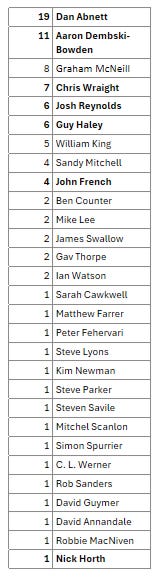
First off, congratulations to first-time winner Nick Horth, who made it in thanks to the grizzled Age of Sigmar duo Hanniver Toll and Armand Callis!
For the rest of the table, Abnett and Dembski-Bowden continued to keep space between themselves and the rest of the pack, but veterans Chris Wraight, Josh Reynolds, Guy Haley, and John French continue to climb.
With 2020 being the last year of Black Library production for Josh Reynolds (Fabius Bile: Manflayer was released in June of that year), his tally for the Hall will soon be locked in place- barring, of course, any future return.
That’s all for this time, thanks for reading!