
The Hall Monitor is published every other week, the same day as the latest installment of the Black Library Readers’ Hall of Fame drops on Tabletop Battles. A cross between a director’s cut and a backstage pass, it’s a look behind the scenes at the Hall of Fame project.
Subscribers note: You are receiving this email since you’re subscribed to the Black Library Features segment of the Warhammer Wordforge. You can easily update your subscription and notification preferences at any time (see here). Thanks for your support!
Every author in the Black Library Readers’ Hall of Fame entered it somewhere for the first time. Even someone like Dan Abnett, with an extraordinary book count now sitting at seventeen hall-of-fame titles, experienced a moment where he instead had zero1.
Rookie moments- those inductions where an author is winning their first award- are exciting times at the Hall. I’m under no illusion that the population of Black Library authors are sitting at the edge of their seat like it’s Draft Day for the NHL, but it’s meaningful enough for some that it makes it extra enjoyable come each induction day.
For instance, here’s Sarah Cawkwell on the inclusion of Valkia the Bloody:

Then Graham McNeill, for False Gods:

And Mike Lee, for Nagash the Unbroken:

What’s also been fun is seeing the authors most familiar to the modern reader beginning to come into the frame as the initiative rolls on. Do you think John French had any idea, back in 2013 as he debuted with Ahriman: Exile, that not only would that series run for four more books, but that he’d go on to pen the Black Library Book of the Year in 2025 with Dropsite Massacre?
Alongside Frech, the Class of 2013 also includes Guy Haley, Peter Fehervari, and Steve Parker. For Haley, who was inducted for his book for Warhammer Fantasy, Skarsnik, it was a heck of a debut year that also included Baneblade and Death of Integrity. Fehervari, of course, kicked off the much-beloved Dark Coil series with Fire Caste, and for Parker this first-time honor came towards the end of a career that also incluced Rynn’s World and Gunheads.
Heresy Fatigue?
We’re now halfway through the 54-book mainline series of the Horus Heresy, and it’s a good time to talk about how this unfolded behind in the scenes with the Committee.
For those who are new to this initiative, we use a sort of bicameral system to determine which books get in. There’s the public, “Vox Populi” vote as well as an eight-member Hall of Fame Committee, and the support of both is essential for any book to get in. Unlike some sports hall of fame where the public vote is essentially a token, public support has a significant weight in the final results.
No series or imprint in the Black Library has ever been anywhere near as successful as the Horus Heresy. Horus Rising, the first book in the series, was released twenty years ago and still has a huge presence in the catalogue. Debates about “which ones are good” and “essential reading lists” abound in the gathering places of social media, and the Heresy is as alive today as ever it’s been.
From the Committee side of things, it was the most prominent example of what you might call “block voting.” That term refers to the practice of voting in books as a group rather than individually. We see this often with popular trilogies, and it’s also quite prominent with long-running character series like Commissar Cain and Felix & Grotrek. Sandy Mitchell’s Cain is an extraordinary character, and naturally those who love Cain tend to reflexively vote for any and all Cain books to get into the Hall.
On the Committee, meanwhile, we take a more granular approach, weighing the merits of each book individually. Did Cain’s Last Stand, the sixth book in the series, do enough on its own to warrant inclusion? Was that book- not the series, but just that book- “culturally, historically, or aesthetically” significant? The Committee is not a monolith; each person serving may have their own ideas and opinions (and usually do!), so if that book can gather the necessary 60% of the overall votes, in it goes.
With something as massive and long-running as the Heresy, the degree to which we’d see block support was a big question we discussed last March. Were the voters just going to auto-pick most Heresy books because they were Heresy? We’d soon have our answer- and it was an interesting look at how the books are regarded.
Here’s a table showing how the Vox Populi voted, with books showing “Yes” under VoxPop crossing the requisite 50% threshold. It also shows whether or not a book made it in, and- just as a lark- whether or not that particular book is part of the new Horus Heresy Saga reprint cycle.
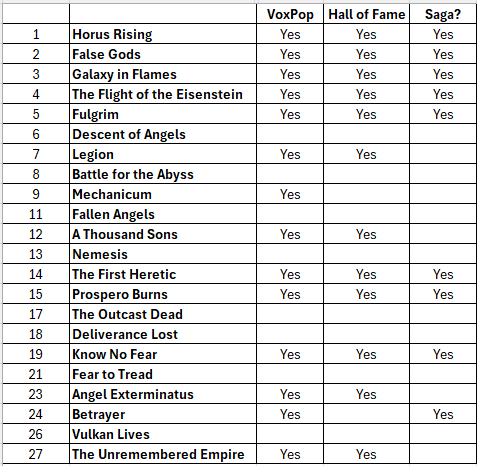
The public voters threw their weight behind the majority of the Heresy titles, fourteen of the twenty-two eligible books (the five unlisted books are anthologies, which aren’t considered). That might seem a bit high on first blush, but it’s worth noting that from this list twelve books ultimately made it into the Hall. It’s not a perfect overlap; the people liked Betrayer and Mechanicum, but they didn’t quite secure enough Committee support to make it in. But you can hardly accuse the voters of irrational exuberance.
Plus, it’s worth noting that nine of the twelve-volume Saga reprint cycle came from the first half of the Heresy. I’d say its clear that the acclaim for the book line is well-warranted.
But if you’d like to see nuance, where it really gets interesting is when you look at the actual data behind that support. Here’s the same table, but I’ve added one more column which shows the percentage of popular support each book received in the polling2.
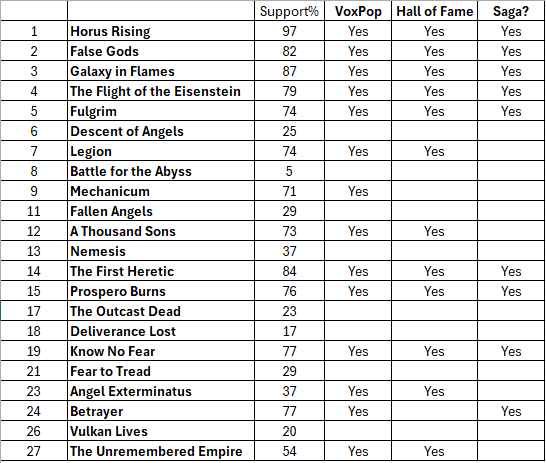
For statheads like me, this stuff is catnip. It also contextualizes the concerns around block voting. Sure the people are throwing a lot of support for most books in the Heresy, but it’s not blind support. The early books enjoy a huge push, but as the series continues to roll out opinions become a lot more split. Note that only 54% of respondents supported the induction of The Unremembered Empire, whereas Horus Rising was almost universal.
Whether or not this represents a kind of voter fatigue versus critical discernment one can only speculate, though the reception to the new Saga suggests that we’re far from over the Heresy- and I’m absolutely here for it. It’s certainly true that the series did suffer from bloat- even the early editors have noted they didn’t plan beyond the first few books and were sort of winging it a bit after that.
But from such moments, sometimes, serendipity happens.
The Vox Populi Top Twenties
So here are the updated Top Twenties for both halves of the Black Library. In weeks past we’ve put the Winners Leaderboard at the bottom, but because the Top 20 lists had no new entries this week, I’ve lead with the table that did.
Hall Winners Leaderboard
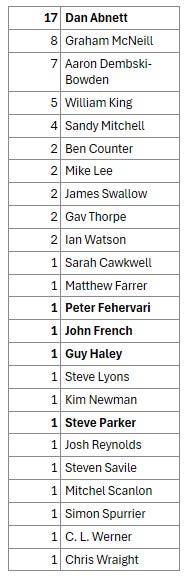
While I talked about the four ‘rookies’ collecting their first-ever Hall induction, we can’t help but notice Abnett nabbed another one as well. When your tally rivals the sum of the next three on the list, it’s safe to say your lead is pretty unassailable. Still, this is one of those lists where you can genuinely say that even making it is probably an honor. I’d certainly like to think so.
Correction notice: Previous iterations erroneously had Ben Counter at 3, this has been corrected to 2.
Fantasy
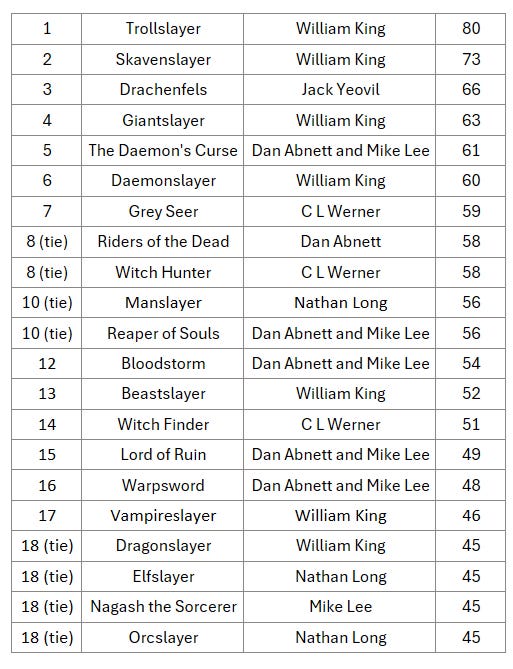
30K/40K
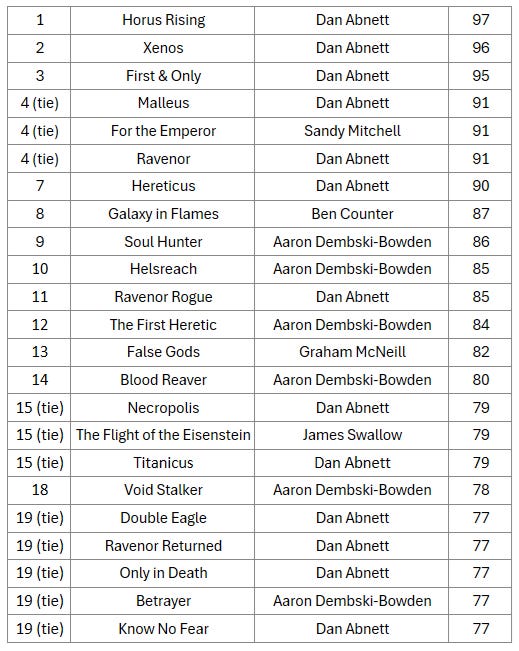
No big breakouts inductions this week to crack the Top 20 on either side. Let’s see if 2014 shakes things up.
That’s all for this time, thanks for reading!
Because 1999 and 2000 were considered as one Class due to the comparatively few titles released at that time, Abnett actually entered the Hall with two wins: one for First & Only, another for Necropolis. Oh, you…
Remember, a book doesn’t need to get more than 50% of the overall votes to advance, because we don’t consider the No Opinion/Abstain votes when making this determination. Thus, a book that gets only 25% of votes in favor of induction, but just 20% opposed (with the remaining 55% abstaining) will secure the Vox Populi endorsement- because more people voted for it than against it.
This is a fascinating look behind the curtain. It completely dispels the myth of blind "block voting" for the Horus Heresy. Seeing how the numbers shift from the universal early support down to titles like The Unremembered Empire shows that readers are applying genuine critical discernment as the saga stretches out, rather than just rubber-stamping everything out of loyalty.