

The Hall Monitor is published every other week, the same day as the latest installment of the Black Library Readers’ Hall of Fame drops on Tabletop Battles. A cross between a director’s cut and a backstage pass, it’s a look behind the scenes at the Hall of Fame project.
Subscribers note: You are receiving this email since you’re subscribed to the Black Library Features segment of the Warhammer Wordforge. You can easily update your subscription and notification preferences at any time (see here). Thanks for your support!
Today we announced the inductees of the Class of 2017. It was a massive class- almost forty books were considered, which is particularly remarkable when you consider that just the year before there were less than half that many. The size of the class was not the only remarkable thing about this cohort; it’s also noteworthy how few of them managed to make it into the Hall. You may recall that the Class of 2016- again, half the size of 2017- managed to get the same number of books in.
What gives?
A big part of this, I think, is reflective of the corporate realities of Games Workshop at the time. Tom Kirby had stepped down as CEO of Games Workshop in 2015, and under his reign the company had been squarely focused on the tabletop lines. When they found they had a massive hit on their hands with the Horus Heresy, they didn’t quite know how to react.
This is illustrated by this from Black Library series editor Ellie Goulding, writing in the afterword of Ben Counter’s Battle for the Abyss:
As the Horus Heresy was growing and evolving through the [earliest] novels, the time scale for everything was in flux. Many of those early books have that exciting feel to them. In the first ten volumes of the Horus Heresy, there were no stars to steer by, no maps to follow.
Only once we began to have authors referencing other extant plotlines within the series did the links between the many books start to become apparent. This wasn’t just a setting – it was a single and incredibly complex story, the full extent of which no one contributor could see until their own work was finished. You think you were confused by whose side the Alpha Legion are on, or whether each of their twin primarchs actually knows what the other is doing? Try being the series editor...
Here today we have the benefit of hindsight, but imagine trying to navigate this terrain back in 2006. While a runaway success is in many ways a nice problem to have, that doesn’t mean that forging the road ahead was easy.
The Black Library’s response was simple: give the people more of what they want. That meant forging ahead by commissioning more and more novels and stories. Rolling out a line of novellas and audio dramas. And since the readers seemed to like the primarchs so much, why not an entire new line of novels- one for each?
And if all that wasn’t enough, then you have the Beast Arises series. This was the Black Library’s answer to two questions. First, since readers clearly liked going back to an earlier time period in the universe, would they like to see another, not quite so early- also get a grand narrative? And second, what if they released a series that modeled itself after episodic television, with an entire 12-book cycle played out on a monthly cadence?
Where perhaps the reach exceeded the grasp was not in trying to do these things, but rather trying to do them all at the same time. There was only so much talent the Black Library could draw upon in its stable, and it should come as little shock that the results have been historically seen as a bit uneven. The Beast Arises in particular has been drawn criticism for being, as one reader succinctly put it, “too many cooks and too many books.”
As a result, we have a Class that- when compared to previous ones- seems very underperforming when it comes to inductees to the Hall of Fame. These were worthy winners, of course, and as with any Hall of Fame there’s always going to be a couple on the cusp that will spark good-natured debate. But while I haven’t run the numbers on this metric directly, an induction rate of around 10% seems like a verdict. A slice of cake for dessert is great, but it doesn’t an entree make.
Now enough about food, let’s get to the books!
The Vox Populi Top Twenties
So here are the updated Top Twenties for both halves of the Black Library, but first a look at the updated Leaderboard:
Hall Winners Leaderboard
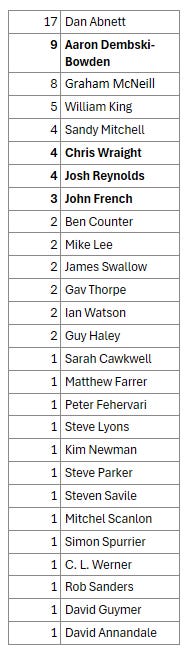
No new names this time around, but interestingly what I see as the “middle tier” increased their totals this week. It’s important to note that “middle tier” is not a qualifying descriptor- these authors certainly aren’t “mid,” but rather just a representation of quantity at this particular time. John French, for example, has only recently entered the scene and while I don’t like to get into the prediction business1 I would be very surprised if this is the last time we see his tally increase.
Fantasy

30K/40K
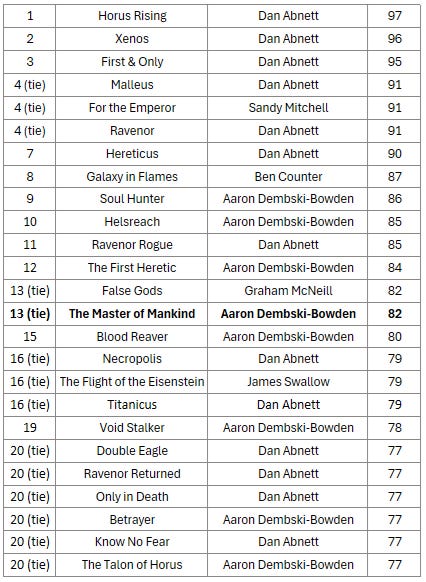
As you’d expect, it’s become much harder over time to crack into the Top Twenty, but Aaron Dembski-Bowden managed it this time around with The Master of Mankind. With 82% of the voting public’s support, he now has eight books on the list- behind only Dan Abnett with thirteen. Of course, four of Abnett’s sit tied at 20th, so all it will take is one more book charting to knock out the lot.
Fantasy, meanwhile, sits static again this week despite its lower barrier to entry. It will be interesting to see which Age of Sigmar book will be the first to make the list.
That’s all for this time, thanks for reading!
As a Hall of Fame Committee member and steering organizer, I’m always wary about anything that even gives the hint of me putting my thumb on the scale.
As someone who only started reading black library 2024 the idea of a series releasing a book a month is insane. We're closing a year since The Scouring started in comparison.