
Back towards the end of 2024, I pitched a history of the Black Library article series to Goonhammer (now known as Tabletop Battles), getting my foot in the door and back behind the writing desk after a break of several years. That got my foot in the door, and while since that time I’ve written a great deal more than just histories (just over a hundred articles in 2025 alone), this series has a special place in my heart.
While ultimately it proved to be a little too niche for Tabletop Battles, like the Black Library Weekly it will be continuing here on the Black Library Dispatch. This series gets asked about a lot, so thank you for your continuing support!
And now, let’s get cracking on the history! Here’s a quick recap of where we’ve been already:
Part One: The Beginning. 1990. Inquisitor and Deathwing.
Part Two: A short pause. 1993. Space Marine.
Part Three: 1994-95. Harlequin and Chaos Child.
Part Four: 1997. Dawn of the Black Library and Inferno!
Part Five: 1997. The first year of Inferno!
Part Six: 1998. Gaunt’s Ghosts and Last Chancers debut.
Part Seven: 1998. Warhammer Monthly’s first ten issues.
Part Eight: 1999. The books are back!
Part Nine: The books of the year 2000.
Part Ten: The short stories and comics of 2000.
Part Eleven: Winter and Spring 2001. Eisenhorn appears.
Part Twelve: Summer and Autumn 2001. Ongoing series continue apace.
Part Thirteen: Winter and Spring 2002. “Gaunt’s Ghosts Coast to Coast”
The Story So Far
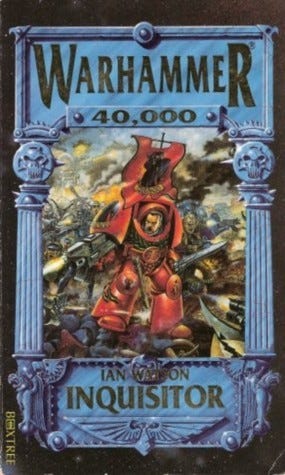
Games Workshop’s first foray into Warhammer 40,000 fiction began in 1990 with the release of the Deathwing anthology and Ian Watson’s Inquisitor. Initially, the company relied on hiring established sci-fi writers, leading to the notoriously wild and unstructured “Watsonian” era of lore seen in Space Marine (1993) and the Inquisition War trilogy. Following the conclusion of those early series, novel publishing went completely silent in 1995.
The Black Library as we know it today was officially formed in April 1997 by Rick Priestley, Andy Jones, and Marc Gascoigne. They pivoted away from sourcing outside novelists and instead focused on cultivating homegrown talent. To do this, they launched Inferno!, a bimonthly magazine packed with short stories, which served as a highly successful proving ground for new writers. This was quickly followed in 1998 by Warhammer Monthly, a comic zine that introduced serialized classics like Bloodquest, Daemonifuge, Titan, and Kal Jerico.
In 1999, the novels triumphantly returned, driven by the success of the magazines. The Black Library found a winning formula in ongoing, character-driven series rather than one-offs. This monumental year brought us Dan Abnett’s First & Only (launching the massive Gaunt’s Ghosts franchise) and William King’s Space Wolf (kicking off the saga of Ragnar Blackmane).
Between 2000 and 2002, the modern foundation of Warhammer fiction was fully cemented. 2001 saw the debut of Inquisitor Gregor Eisenhorn in Abnett’s legendary Xenos. By the first half of 2002, Graham McNeill arrived on the scene, delivering the first Uriel Ventris novel, Nightbringer, and arguably the first true Chaos-won narrative, Storm of Iron.
By the end of 2002- where we’ll end up today- the Black Library had transitioned from a fledgling “noble experiment” into a well-oiled machine, boasting a stable of foundational authors and the defining series that continue to shape the grim, dark future even now.
Connective Tissue: The Black Library Readers’ Hall of Fame
Starting in this installment we’re going to highlight the overlap between the Black Library’s history and the Black Library Readers’ Hall of Fame, our ongoing project at Tabletop Battles. After all, seeing what books have been selected by readers as having the greatest “cultural, historical, or aesthetic significance” is certainly a part of the story.
From those years before the official founding of the Black Library, we’ve inducted Inquisitor and Space Marine by Ian Watson. Then as noted above, 1999 brought us First & Only and Space Wolf, with Abnett’s second Ghosts book, Necropolis, joining a year later.
Then in 2001, Abnett’s Eisenhorn books Xenos and Malleus made it to the Hall, followed in 2002 by Storm of Iron. And as we’ll see today, there was one more induction from 2002.
The Novels of 2002
A full eight novels were published for Warhammer 40,000 in 2002, a number that may seem small by contemporary standards but was certainly reflective of the Black Library’s tremendous growth at the time. Five of these landed on bookshelves in the first half of the year (covered previously here), leaving just three to go- but what a trio they were!
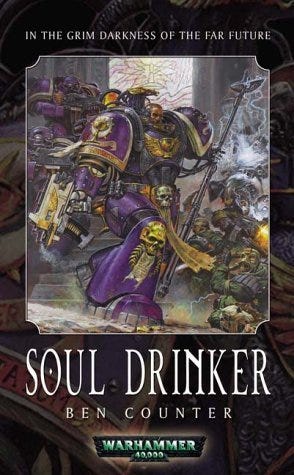
Soul Drinker, by Ben Counter
If you wanted to get a proof of concept of the “Black Library” pipeline, look no further than Soul Drinker. Writer (and Golden Daemon-winning painter) Ben Counter had been writing short stories for Inferno! as early as issue #12 in 1999 (the Sororitas story Daemonblood), and buoyed by this early success he pitched the editors on some novel ideas he’d come up with. One of these ideas would become Soul Drinker1.
This was a time when writers were just starting to see what could be done within the worlds of Warhammer, and to his (and the editors’) credit Counter didn’t play it safe. Instead of going for Space Marines or even Chaos Space Marines (itself somewhat uncharted territory), Counter imagined an Astartes chapter that instead were “renegades,” rejecting both and forging their own path.
The book has enjoyed enduring acclaim, as evidenced by its induction into the Black Library Readers’ Hall of Fame.
Soul Drinker “introduces a proud chapter of Space Marines and forces them to take a rare, alternative path,” noted Hall of Fame Committee member Michael Dodd (of Track of Words). “You don’t get books like this from the Black Library any more, and that’s a shame – the grey areas between order and chaos have so much scope for storytelling.”
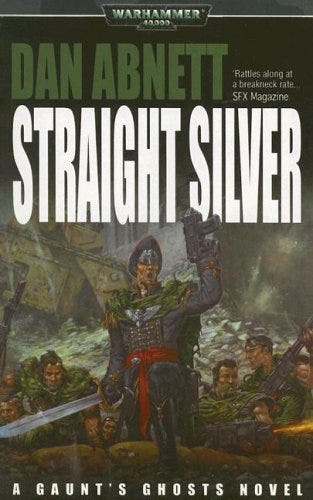
Straight Silver, by Dan Abnett
By this point, Abnett and the Black Library have a franchise hit on their hands in the Gaunt’s Ghosts series, and don’t they know it. Abnett produced five Ghosts novels between 2000 and 2002- and would release another each year until 2007.
What’s particularly impressive is the way in which he did it. A pulp novelist might be tempted to just “go with what’s selling” and crank out variations on a theme, but Abnett continually pushed himself to take the series in different directions. As I noted when we welcomed His Last Command (2006) into the Hall of Fame:
Dan Abnett’s genius with the Gaunt’s Ghosts series was his ability for reinvention. A series that simply focused on one battle or another might be entertaining, but the changes that Abnett undertook on one of his most successful series went a long way into elevating it. Necropolis was urban, siege warfare, while Straight Silver took them into the bloody grit of trench warfare. With Traitor General, the preceding book, Abnett put his characters on an infiltration mission, and here in His Last Command we see Gaunt’s enemies just as much within his own command structure as on any battlefield. These were risks- and they paid off, as another Gaunt’s book enters the Hall.
By placing the Ghosts in “World War I trench warfare2“ he not only changed up the terrain, but he also upped the stakes. The Tanith First & Only is a stealth and reconnaissance unit, a specialty that has far narrower utility in the confines of entrenchments.
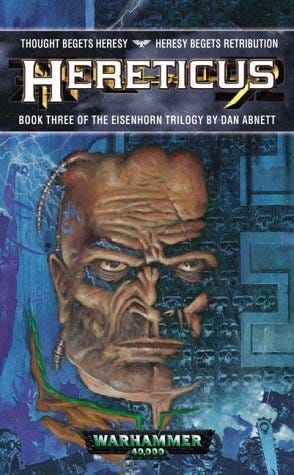
Hereticus, by Dan Abnett
It can often get obscured by the mists of time, but the interplay between paper and plastic3 is essential to understanding the full, rich history of the universe. Abnett, for instance, wrote Xenos- the first book of the Eisenhorn trilogy- as a direct result of the impending launch of the Inquisitor tabletop game.
By the time the arc concludes with Hereticus, the roles have reversed. Abnett’s tale of Eisenhorn’s butcher’s bill coming due as he descends into late-career radicalism hit the bookshelves in July, and many of its central concepts about the Inquisition would find their way to the tabletop the following year in Codex: Daemonhunters. Meanwhile, White Dwarf magazine bridged the gap between the two with articles like Index Malleus: Infernal Threat - An investigation into the foul Daemons of the Warp from that October’s issue.
The Eisenhorn trilogy would go on to spawn further Inquisitorial adventures from Abnett in the Ravenor and Bequin series, remaining a “gateway book” into the universe even in the present day.
Tales from the Inferno
Writing in the editor’s intro for issue #31, Marc Gascoigne broke the news that he was moving on from the position. “It’s not that I’m going away,” he noted, “it’s just that the success of the Black Library novels is taking all my time, so I think it’s only fair to hand over to an editor who can devote all of his energies to making the BL magazines the best around.”
He wasn’t kidding. In 1999- the year the Black Library novels started to appear- they published six books. Just three years later, that number had doubled. It would nearly double again in 2003. With the reins handed over to Christian Dunn, who had come aboard as Assistant Editor back in issue #19 (July/August 2000), it was full steam ahead.
The stories of the three issues from the back half of the year included:
Blackcloth for a Crown Additional, by Dan Abnett. An Eisenhorn short story set between Malleus and Hereticus and bearing one of the best story names ever, Blackcloth sees Gregor and his band investigating a mysterious death involving a country fair. Accompanied by an illustration by Simon Davis. (Inferno! #31)
Blue Blood, by Dan Abnett. Accompanied by an illustration by Clint Langley. When an ancient evil threatens to spoil the coronation of a new king in Iorgu City, can a delegation of Iron Snakes stand in its way? (Inferno! #33)
Fight or Flight, by Sandy Mitchell. Accompanied by an illustration by Stefan Kopinski. Mitchell reaches back in time for a tale of a young Commissar Cain, thrilled at landing a safe, cushy posting- at least until the Tyranid arrive! (Inferno! #33)
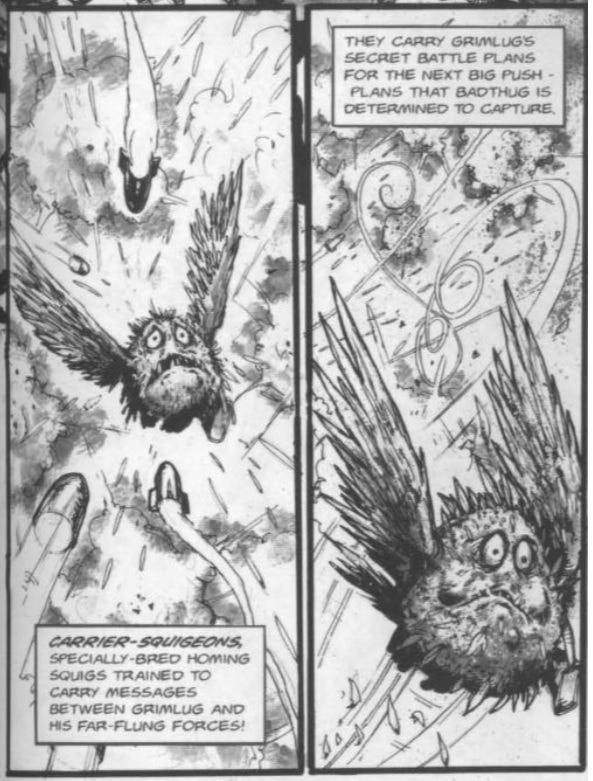
Katch Da Squigeon, by Gordon Rennie (script) and Paul Jeacock (art). A Deff Skwadron comic, the Skwad look to intercept the plans of the enemy warboss- by capturing the messenger “squigeon” used for their communications. See the illustration above- it really is as wonderfully bonkers as it sounds. (Inferno! #31)
Liberation Day, by Matthew Farrer and Edward Rusk. Accompanied by an illustration by Stefan Kopinski. Spartacus, anyone? When a slave rebellion breaks out on a space hulk, can they hold out long enough against the Orks to be saved? Farrer’s third short story for the magazine, he’d be back with a novel in the year following. (Inferno! #31)
On Mournful Wings, by Si Spurrier. Accompanied by an illustration by Paul Jeacock. This short follows in the footsteps of books like Ian Watson’s Space Marine and Space Wolf by William King, telling a tale of the perilous path that leads to induction into the Adeptus Astartes. (Inferno! #32)
Payback, by Graham McNeill. Accompanied by an illustration by Simon Davis. “With Payback,” notes McNeill, “I wanted to write a story with a central character who was a swine of the highest order, yet one who you still wanted to come through in the end.” Set on the planet developed for the Inquisitor board game, Karis Cephalon, it was intended to be part of an anthology of setting-linked stories he’d Gav Thorpe (and others), but ultimately it didn’t pan out. (Inferno! #32)
Visions from the Inferno
Unlike in previous issues, there weren’t any special illustrated segments in the latter issues of 2002. No schematics, no cutaways, and no portraits- but we did get some nice cover art.
Liber Chaotica: Tzeentch, by Adrian Smith. Smith’s Chaos Space Marine graced the cover of issue #32.
When Raptors Attack, by Clint Langley. Meanwhile in the issue previous, #31, it was a flight of Raptors. I guess Chaos was having a moment!
Meanwhile in Warhammer Monthly
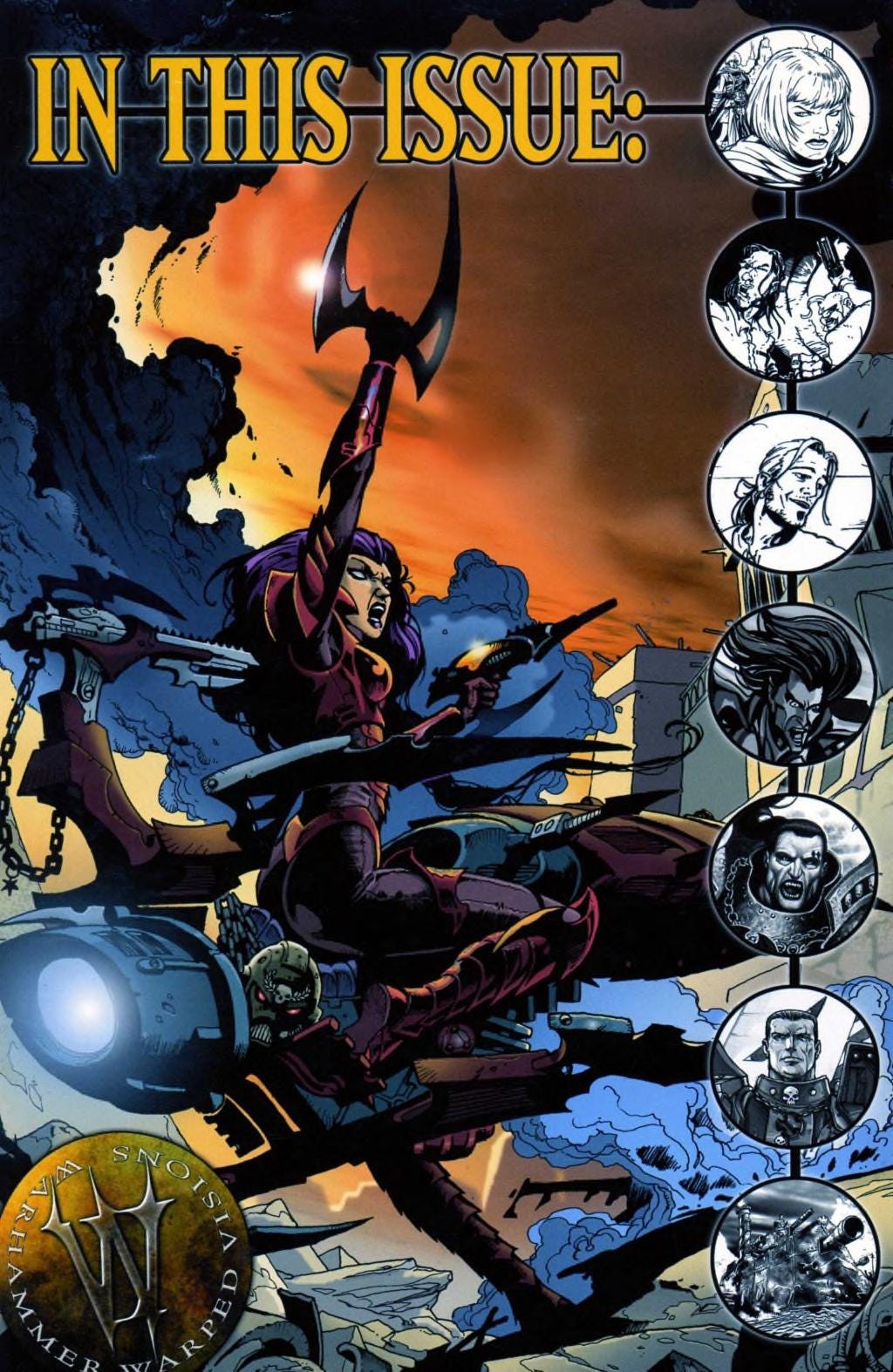
“Taking your favourite characters and setting their stories somewhere else has been around for donkey’s years,” noted Editor Marc Gascoigne in issue #63. “It’s probably uncool to admit it, but some of us at the Black Library remember all those Michael Moorcock novels and Justice League comics of the 1970’s when just this sort of malarkey went on all the time. But then that’s too modern a take, because there were probably even Victorian parlous games where one did just that. So this sort of genre-hopping fun isn’t trendy...but it sure is entertaining.”
Issue #63 was another double-sized Christmas issue, following in the footsteps of issue #50 the previous year which featured a full-color section and Redeemer strip. To hear Dunn tell it, the idea quickly went from “that’s crazy” to “so crazy it just might work” territory. What if, the pitch went, we took 40K and Fantasy characters…and switched their places?
And so, for one issue only, readers enjoyed Sister of Sigmar Ephrael von Stern, fantasy rogue Cal Gerrico, Maless Darkblade of Comorragh- and more!
The stories of the latter half of 2002 were:
The 19’ers, by James Peaty (script) and David Millgate (art). The start of a new series, this sees Catachan Guardsmen taking on Orks in the jungle. (Warhammer Monthly #62)
Bloodquest III, by Gordon Rennie (script) and Colin MacNeill (art). Blood Angels Cloten and Lysander strike against the Black Crusade. (Warhammer Monthly #58, 59, 60)
The Bridge, by Dan Abnett (script) and Simon Coleby (art). This was very first complete release for the new magazine when Warhammer Monthly began in 1998, and was reprinted here in issue #61.
Charnel House, by Jim Alexander (script) and Jim Brady (art). The Imperial Fists are put to the test when they take on the Death Guard. (Warhammer Monthly #61)
In the Jungle, the Quiet Jungle. A lore section on the notorious Catachan Jungle Fighters. (Warhammer Monthly #62)
Kal Jerico: Above & Beyond by Gordon Rennie (script) and Wayne Reynolds (art). The Inquisition, Necrons, a Space Hulk, and… family? The Necromundan bounty hunter has no shortage of perils in this multi-part adventure that will continue into 2003. (Warhammer Monthly #57, 58, 59)
Lone Wolves, by Dan Abnett (script) and Karl Richardson (art). Survivors of an Imperial Guard regiment are stranded on a Tyranid-infested ice world. Things look bleak- until they run into a detachment of Space Wolves. (Warhammer Monthly #57, 58, 60, 61)
The Lost Companies. Tying in with Lone Wolves is a lore spread on the Space Wolves and Wulfen. (Warhammer Monthly #60)
Scabbs, by Gordon Rennie (script) and Roman Sydor (art). Kal Jerico’s sidekick finds a new partner- and a whole lot of trouble. This becomes Scabbs & Yolanda after the first installment. ((Warhammer Monthly #60, 61, 62)
Slavebreak, by Jonathan Green (script) and P. J. Holden (art). Miners who live like pit slaves beneath Necromunda have finally hit a breaking point… (Warhammer Monthly #57)
And here’s the world-swapping one-shots in issue #63, taking the familiar heroes of Warhammer Monthly and reimagining them on the other side of the sci-fi/fantasy divide:
Cal Gerico: Pirates, by Mitchel Scanlon (script) and Daniel Lapham (art).
Ephrael Stern: Sister of Sigmar, by Jonathan Green (script) and Patrick Goddard (art).
Inquisitor Grimm, by Mitchel Scanlon (script) and The Sharp Brothers (art).
Maless Darkblade, by Dan Abnett (script) and Kev Hopgood (art).
Titan, by Gordon Rennie (script) and Anthony Williams (art).
Ulli and Marquand: The Expendables, by Jim Alexander (script) and Steve Roberts (art).
And that’s a wrap for 2002! Thanks for joining me on this exploration of the Black Library’s rich and incredible history here at its new location, and keep an eye out for the next installment!
Footnotes
He speaks a little about that time in a recent interview in The London Economic promoting a novel written entirely in verse.
Abnett put it plainly in this interview from 2011.
Or metal, resin, whatever.