
Warhammer wargame books and novels are packed with incredible drama, but they aren't written for the GM's screen. Each installment of RPG Conversions strips down the lore, builds the encounters, and adapts Warhammer's best stories for your favorite tabletop RPG systems.
Subscribers note: You are receiving this email since you’ve subscribed to the RPG segment of the Warhammer Wordforge. You can easily update your notification preferences here at any time. Thanks for reading!
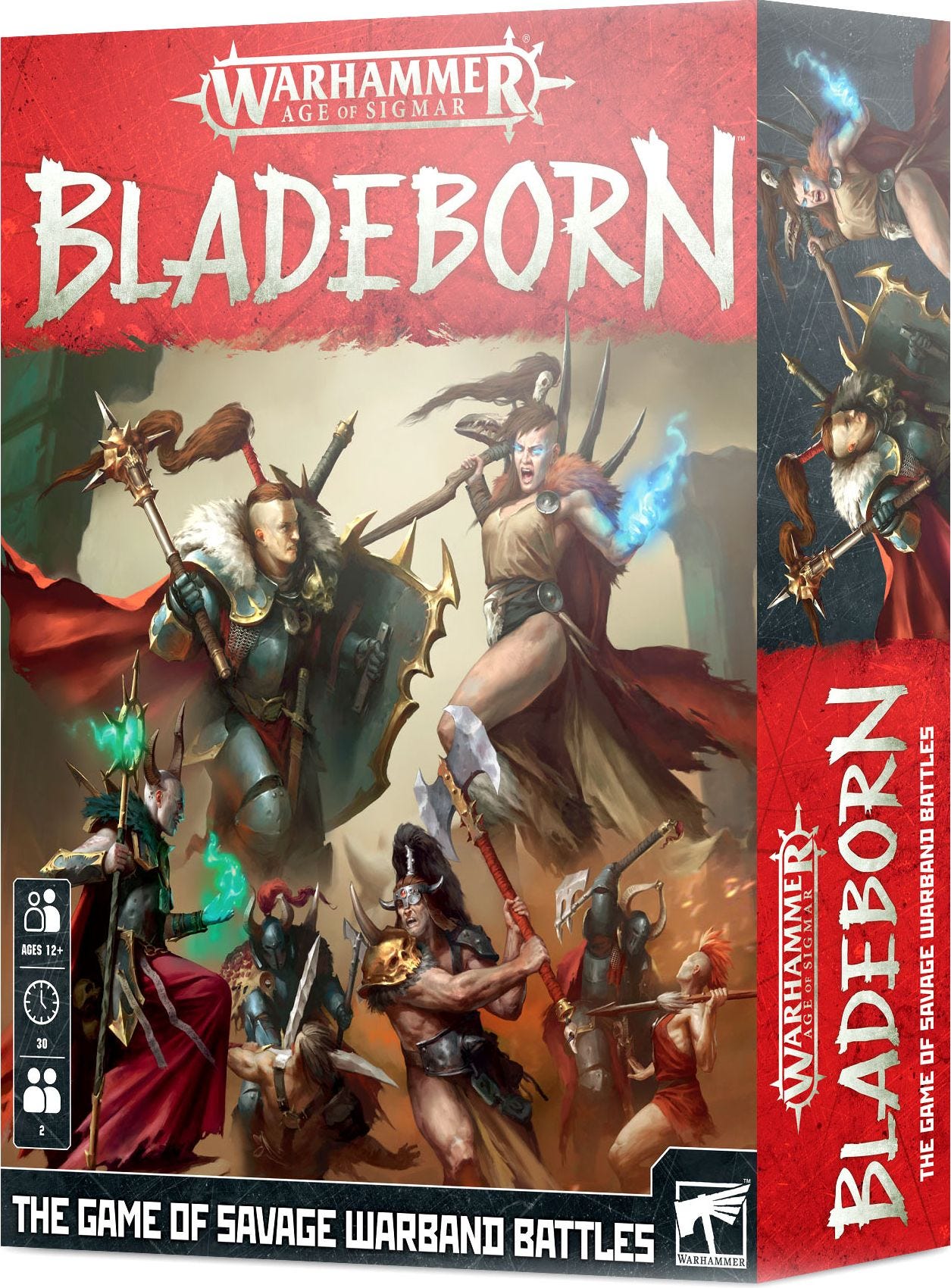
Released in 2021, the Age of Sigmar: Bladeborn box combined the warband skirmishing of Warcry with the hex-based movement of Underworlds. As with most of Games Workshop’s other board game releases, it’s intended as a pick-up-and-play release that can serve as a gateway into the mainline game ranges.
Setting up on opposite sides of the board were two Chaos warbands, Khagra’s Ravagers and the Godsworn Hunt, and today we’ll be adapting both to the Soulbound RPG.
With the recent release of Soulbound: Champions of Chaos, GM’s have plenty of options to use one of both of them to spice up their player’s adventures. Whether as allies or adversaries, each bring something very different to the table and we’ll have a number of tips for integrating them into the campaign.
Finally, for the avoidance of doubt these are an unofficial adaption, the result of my own work and not intended to represent Games Workshop or Cubicle 7 Games. As GM, you’re the final arbiter of what you use at the table, so feel free to adjust any aspects you like to suit your tastes and preferences!
About this Conversion
I’ve long been one of those folks who enjoy picking up old Warhammer tabletop books just for the lore. Used bookshops are terrific for this, and when I recently found the Warcry: Tome of Champions 2021 book at Half-Price Books for six bucks, well, I couldn’t resist.
Within was an absolute treasure trove of game data for all sorts of different warbands, and as I flipped through the pages it didn’t take long for the GM in me to wonder how they might translate to the role-playing realm.
In creating the Soulbound NPC profiles for each of the two warbands, I looked not only at their Warcry: Tome of Champions entry but also their Age of Sigmar warscrolls and Underworld cards, to try and get the best overall sense of each character. Because these are both Chaos-aligned, I drew from Soulbound: Champions of Chaos for some of their makeup. If you don’t yet have access to Soulbound: Champions of Chaos, feel free to make any necessary substitutions.
Note that text in grey (like this callout block) is excerpted from the primary source(s). Here the Warhammer Vault has proved particularly invaluable. If you’re not familiar with the Vault, it’s one of the benefits of a Warhammer+ subscription.
Khagra’s Ravagers
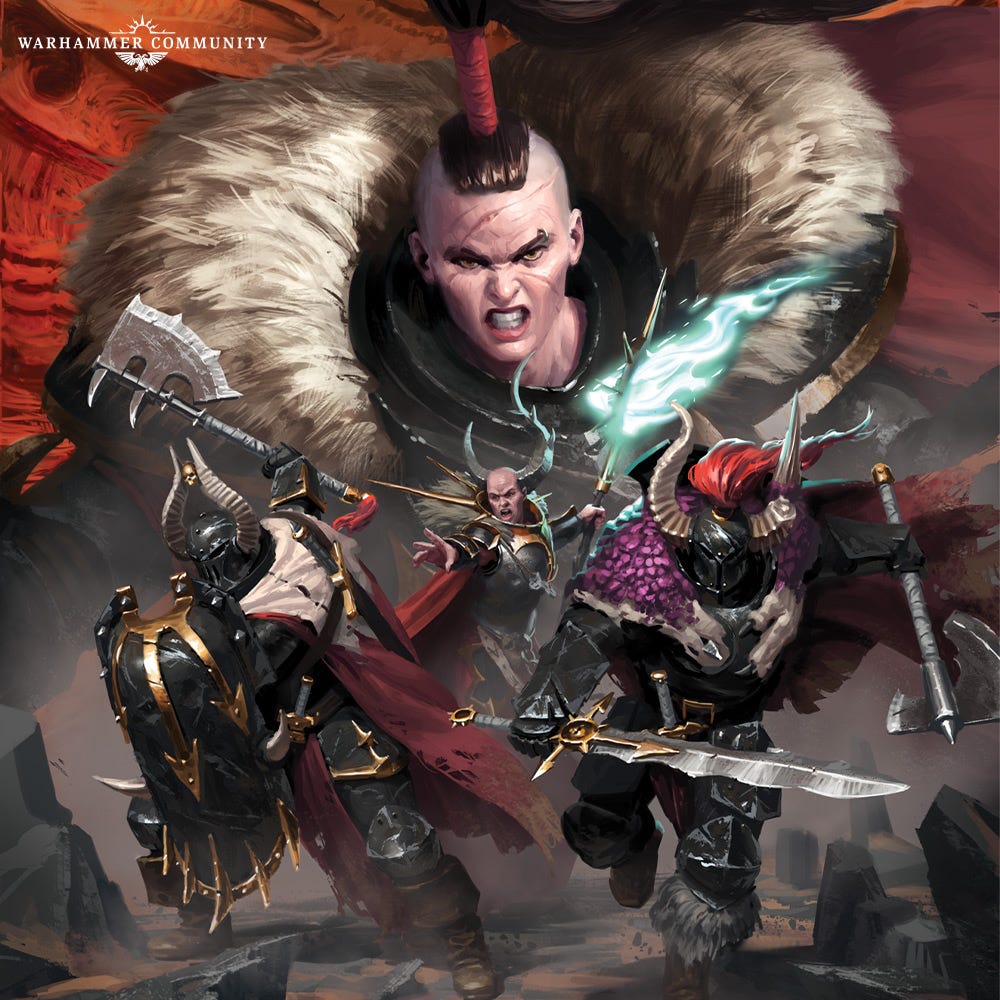
Khagra’s Ravagers are an elite, four-member Slaves to Darkness warband- one riven by internal power dynamics that are never far from once more boiling into the open.
At its heart are the sisters Kharga the Usurper and Zarshia Bittersoul, whose uneasy relationship provides plenty of opportunity to drag players into their web of scheming and betrayal.
Of the many motives that lead warbands into the dark heart of Beastgrave, few are as brazenly violent as that which drives Khagra the Usurper and her band of Slaves to Darkness. As they see it, the mountain will be the culmination of their personal path to glory; a final proving ground where they will earn the attention of the Dark Gods. They intend no less than to dominate Beastgrave itself, turning it to the service of Chaos by desecrating the mountain’s every chamber through dark sorcery and brutal sacrifice.
Though the Aspiring Champion Khagra now leads the warband, it was not always so; her sister Zarshia Bittersoul once commanded the loyalty of the group. When they first entered Beastgrave, Zarshia led them into a gnashing chamber that would have slain them but for Khagra’s quick reactions. She wedged her shield between the cavern floor and the encroaching ceiling, before carving a way out of the rocky gullet.
As the group emerged, the brutal warriors Cragan and Razek turned to Khagra for direction, and she has led them since. Nevertheless, Zarshia has not abandoned her own ambitions, and is ever poised to overturn her upstart sibling when the opportunity arises.
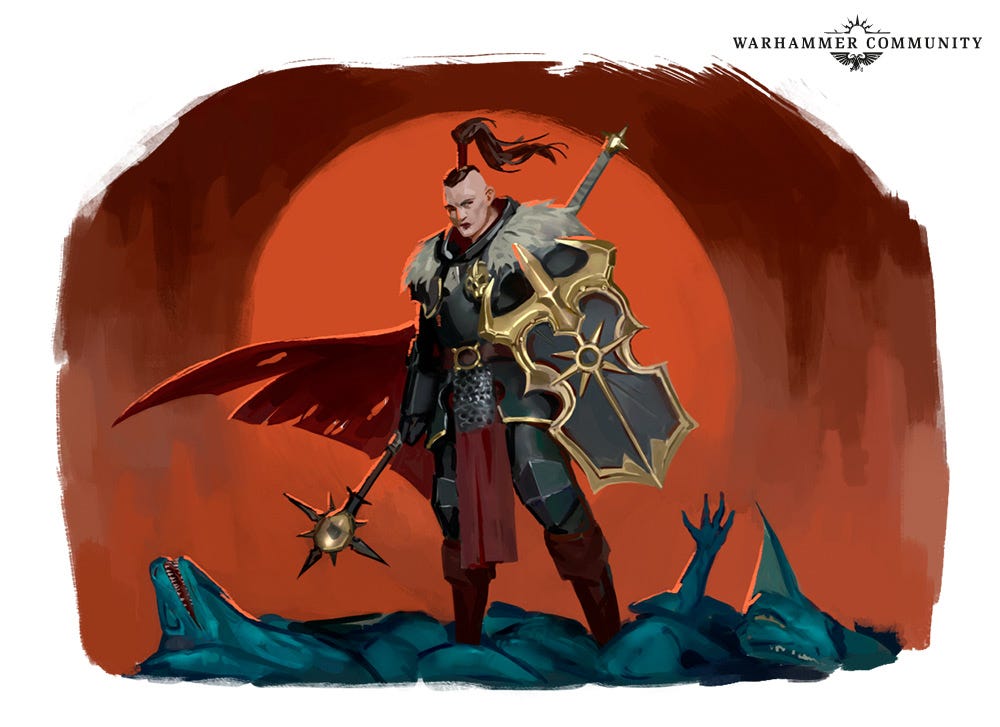
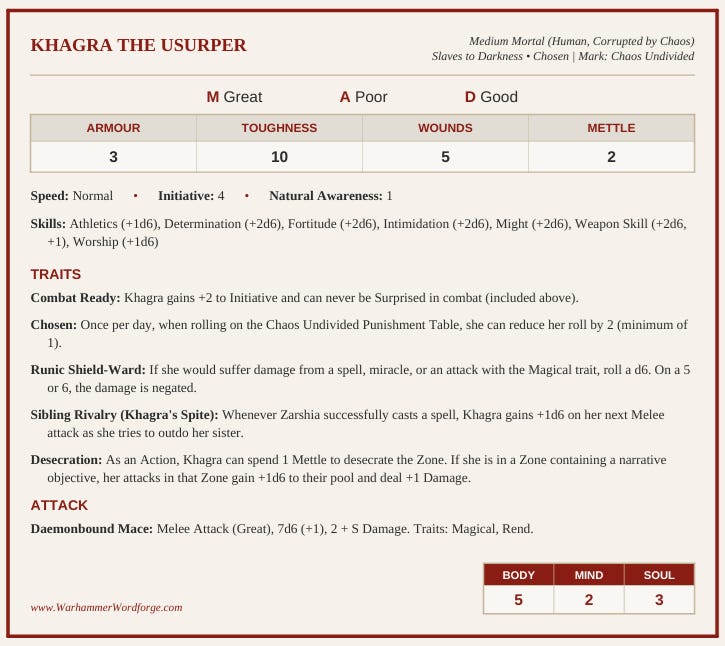
Khagra the Usurper is the leader of the namesake warband. She and her warband were once led by her Chaos Sorcerer sister Zarshia Bittersoul. However, when they first entered Beastgrave, Zarshia led them into a gnashing chamber that would have slain them but for Khagra’s quick reactions.
The Aspiring Champion wedged her shield between the cavern floor and the encroaching ceiling, before carving a way out of the rocky gullet. As the group emerged, the brutal warriors Cragan and Razek turned to Khagra for direction, and she has led them since.
Since their time in the Beastgrave, Khagra has become a Chaos Champion and in her realm-spanning travels, she has faced and defeated towering troggoths, brutish orruks and the lightning warriors of Sigmar’s Stormcast Eternals. Eventually, she led her warband to the Eightpoints. She claims that only one soul in the Eightpoints could stand against her – and she travels there to seek a place in his legions.
One of the first things I looked at when building Khagra was mapping her unit point value in the wargame to her adversary tier in Soulbound, developing a guideline that would help me determine the potency of each member of the warband:
Chosen: 180+ points
Champion: 105-179 points
Warrior: 50-114 points1
Minion: <50 points
Khagra easily clears the Chosen tier, opening up the opportunity for Wounds and Mettle to help make her a truly formidable presence2. She also has a few bespoke traits that help bring her to life.
Runic Shield-Ward is a carryover from her tabletop ruleset, which allows her the opportunity to damage from magical attacks. It’s only a one-third chance, but such are the fickle whims of Chaos!
The Sibling Rivalry traits bring the warband’s core personality dynamic to mechanical life. As each strives to outdo the other, they gain a bonus when seeing the other successful on the battlefield (you’ll see the other half of this in a moment).
Finally, Desecration reflects Khagra’s wicked delight in despoiling and corrupting the sacred spaces of her enemies. This is another nod to her objective-centered tabletop origins, but can give her a situational boost perfect for the climactic final battle of an adventure!
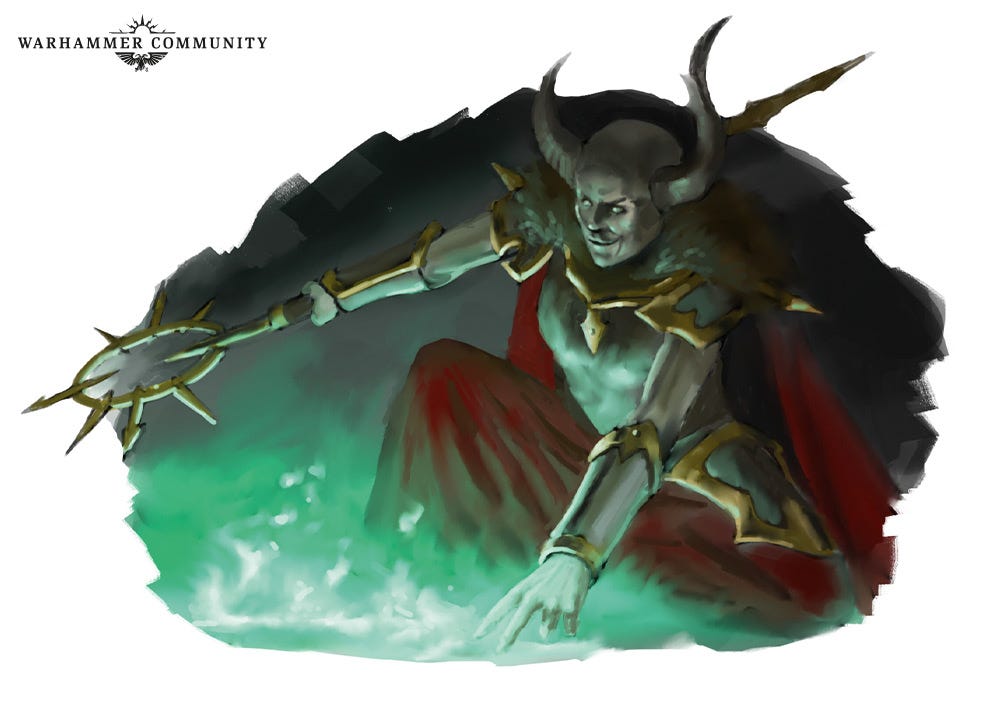
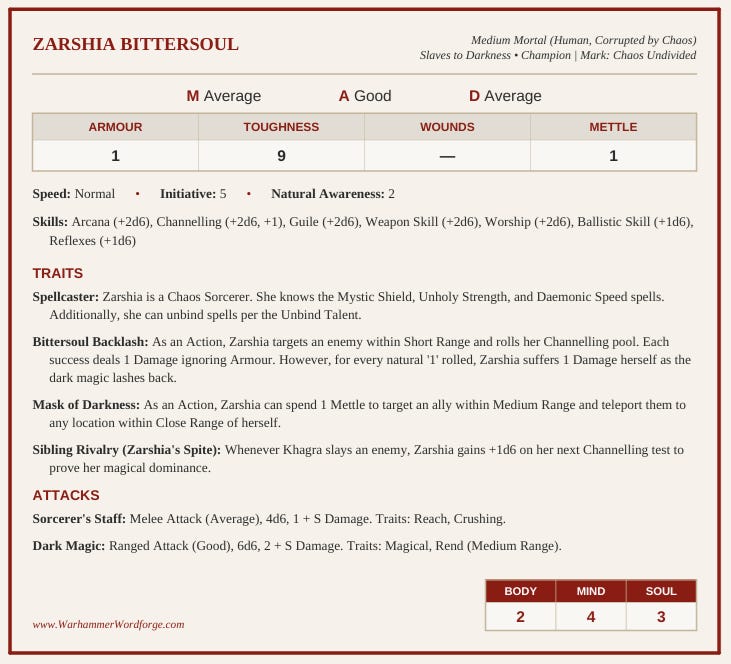
Zarshia Bittersoul is a Chaos Sorcerer who once led the warband now known as Khagra’s Ravagers. When they first entered Beastgrave, Zarshia led them into a gnashing chamber that would have slain them but for Khagra’s quick reactions. Since then, the rest of the warband has looked to Khagra as the leader.
Bittersoul Backlash is a potent attack that’s a nod to Zarshia’s skirmishing origins. She can dish out some solid damage, but she won’t be able to do it for long- especially if she starts drawing fire of her own.
Mask of Darkness is a nifty bit of battlefield generalship, teleporting one of her warband to where they’re most needed. Often that will be springing an ambush on their enemies, but can also be used in a pinch if she’s under threat to being in a defender.
Finally, Zarshia’s Spite is her version of Sibling Rivalry. Each time Khagra lays someone low, her rage fuels a surge of mystical might.
Note also that under attacks she’s got Dark Magic, which is in keeping with her Warcry abilities. It’s a streamlined option for quicker combat, but feel free to substitute standard castings of Chaos Bolt instead.
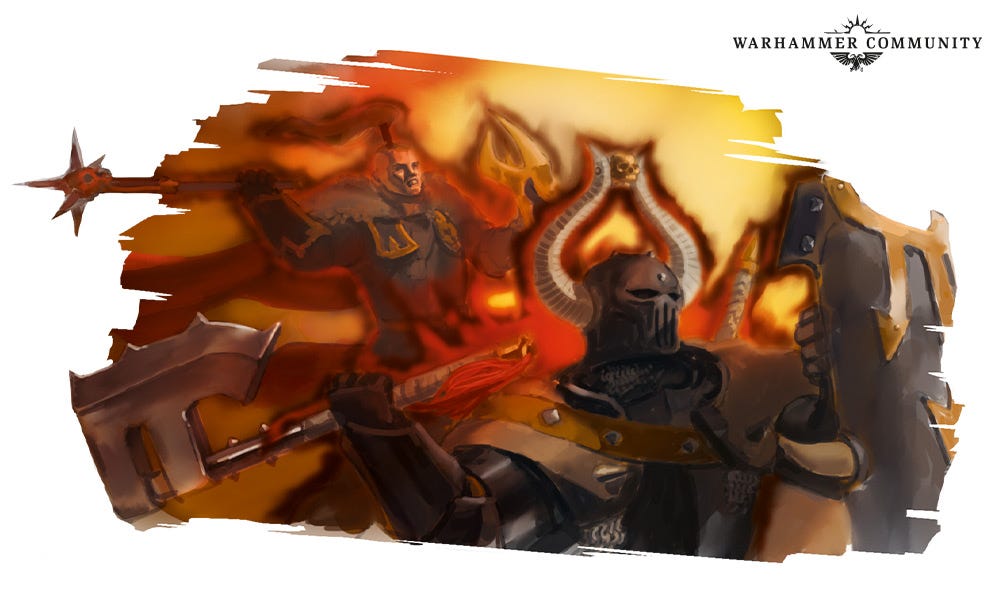
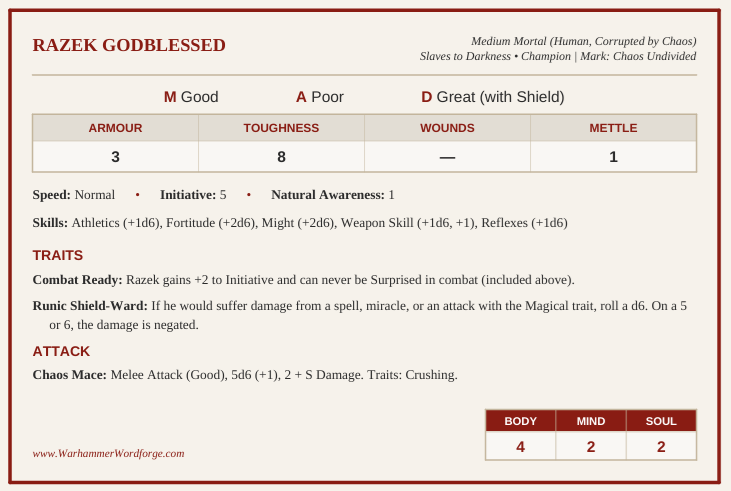
Razek Godblessed is a Warrior of Chaos armed with a Hellforged Sword and Chaos Runeshield.
Not a very inspiring bio, is it. Clearly the sisters are the personalities in the group, with Razek and Cragan serving more or less as their mooks. Of course, given the intrigue between the sisters you certainly will have opportunities to flesh out his personality as you like.
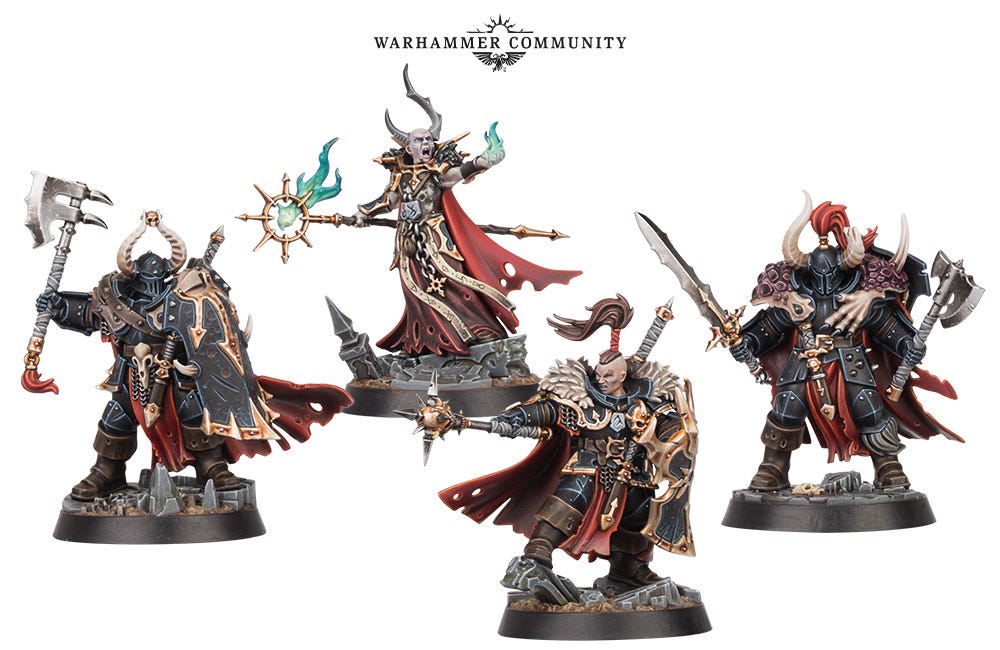
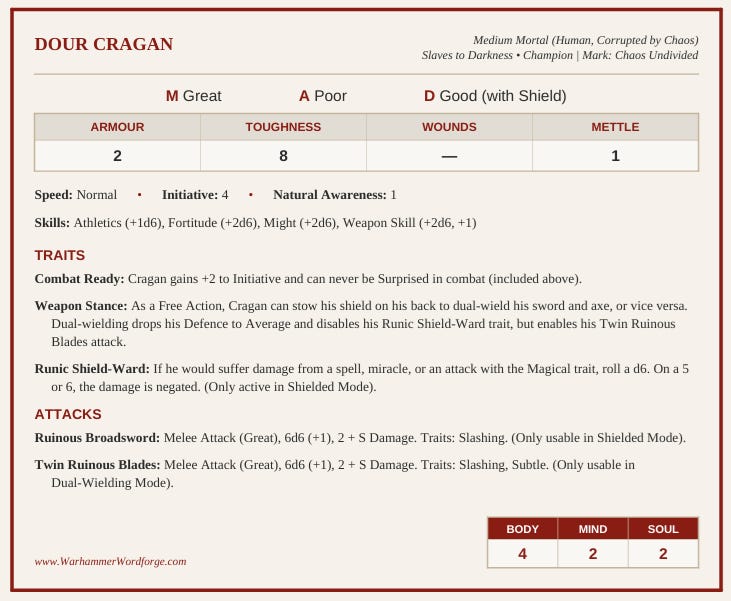
Dour Cragan is a Warrior of Chaos armed with a Hellforged Axe and Sword.
Dour Cragan’s model shows him dual-wielding a broadsword and axe, but he also has a shield strapped to his back. I’ve given him statlines for both stances, letting him adapt to battlefield conditions as he sees fit.
When more offense is called for, the two blades give him considerable flexibility on the offense given Soulbound’s dual wielding rules. On the other hand, Cragan didn’t get where he is by being a fool; if he’s up against any magical attacks he knows he’s better protected due to Runic Shield-Ward.
How to Use Khagra’s Ravagers
While Bladeborn intended for Khagra’s Ravagers and the Godsworn Hunt to be well-matched, under Soulbound’s conversion that goes right out the window in large part due to the Ravagers’ heavy armor. They’re certainly the stronger of the two, so canny players may try to exploit the tensions between the two sisters before combat is even joined3.
For heroic parties, the Ravagers make great opponents for adventures tied to a particular location, such as a consecrated holy site or a Sigmarite temple. Here Khagra’s Desecration ability can come to bear as she tries to profane that which is sacred.
Alternately, rather than having the party defend a location, they could be tasked with investigating a source of corruption. Perhaps the fish in a river feeding a town start to die off mysteriously, the water turning a strange and unsettling color. Players investigating would eventually find Khagra and her warband set up in a ruined outpost upstream, introducing unspeakable concoctions into the water to weaken the town before a raid. What constitutes a “narrative objective” for the purposes of her ability is wide open and entirely up to the GM.
The Godsworn Hunt
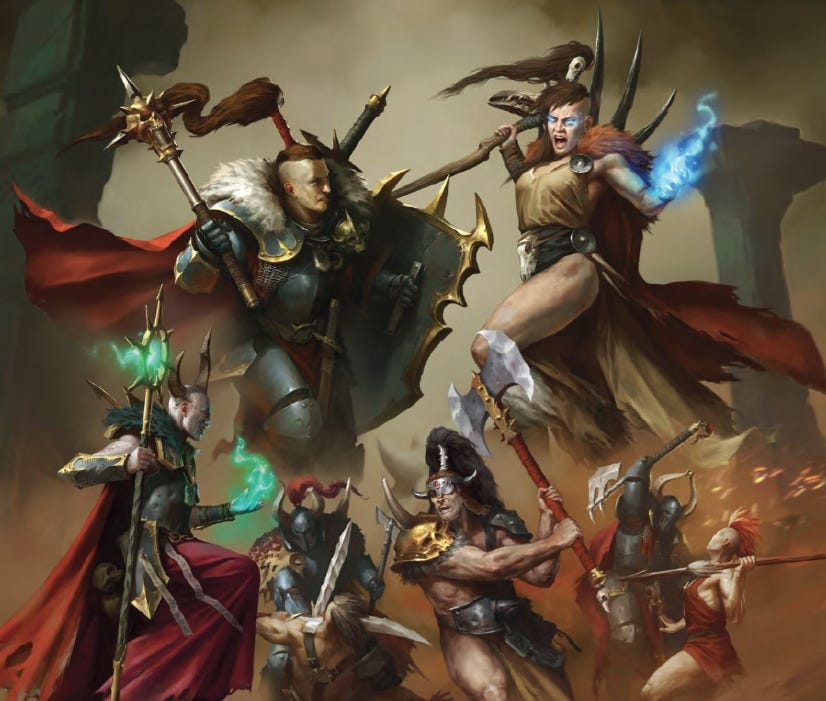
Much more volatile and unpredictable are the members of the Godsworn Hunt, a warband of more mobile harriers and harassers as compared to the hammer-meets-anvil brute force of the Ravagers. Players whose members include Stormcast Eternals will find them particularly nettlesome…
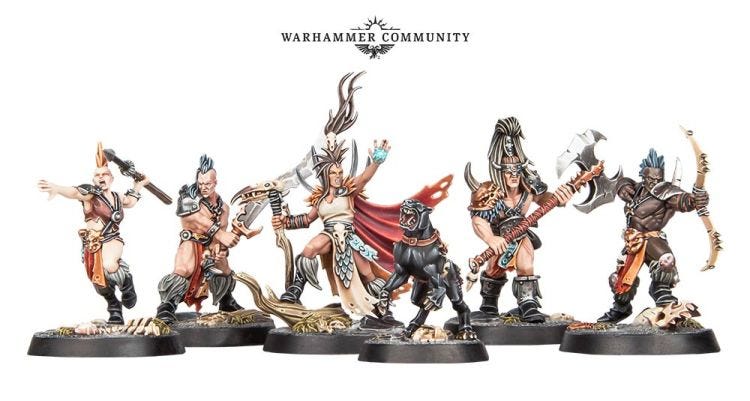
The Tribe of the Black Fang are one of the countless tribes that, over the centuries, have pledged themselves to the Ruinous Powers. None amongst their number are more infamous than the shaman Theddra Skull-Scryer and the warband known as the Godsworn Hunt. All these warriors consider themselves to be Darkoath, swearing great pacts to the dark pantheon in return for reward. Yet the oath made by the Godsworn Hunt is particularly ambitious: they have sworn the Pact of Soul and Iron, offering the lives of Sigmar’s Stormcast Eternals in sacrifice to the gods.
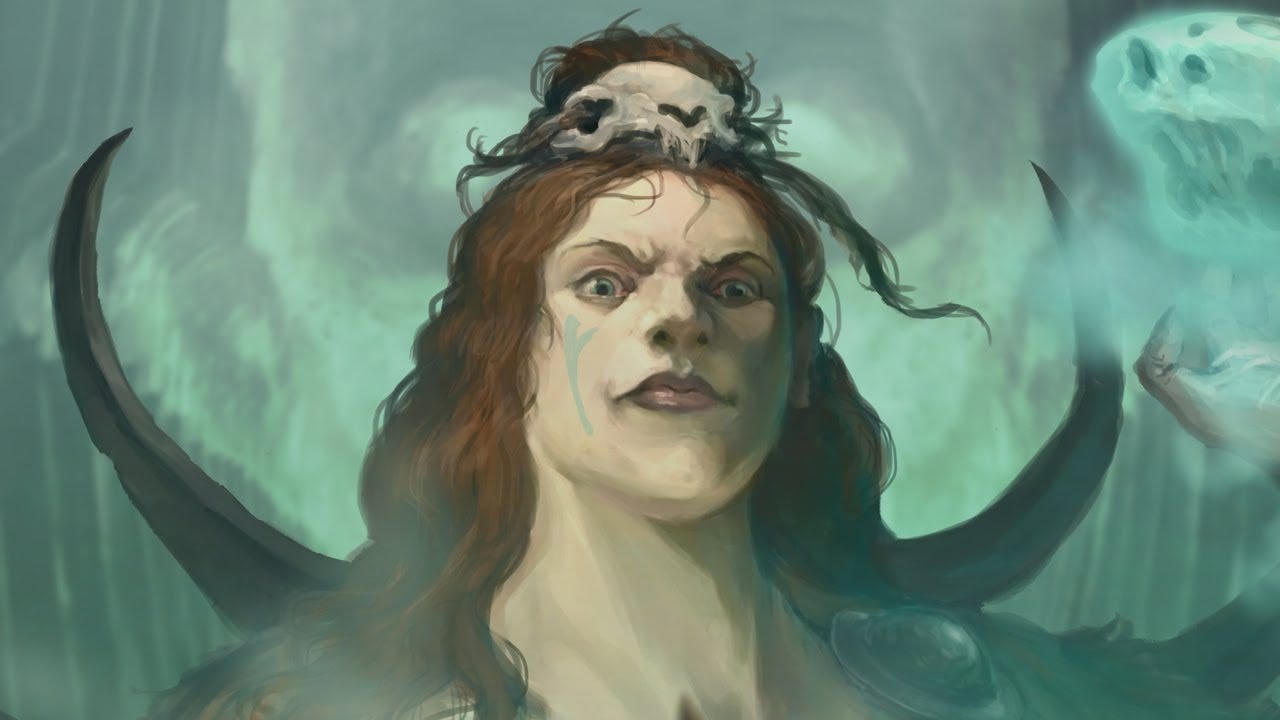
Theddra Skull-Scryer is the most infamous warrior of the Black Fang and the leader of the Godsworn Hunt. Ambitious and utterly ruthless, the war shaman plots to lead the Tribe of the Black Fang. To do so she will need to prove her might with a worthy sacrifice, in the form of Stormcast Eternals. Skull-Scryer’s command of magic is powerful and instinctive, and those assailed by her sorceries find their bodies become withered and emaciated as all vitality is drained from them. Such enforced weakness makes them easy prey for the remainder of the Godsworn Hunt.
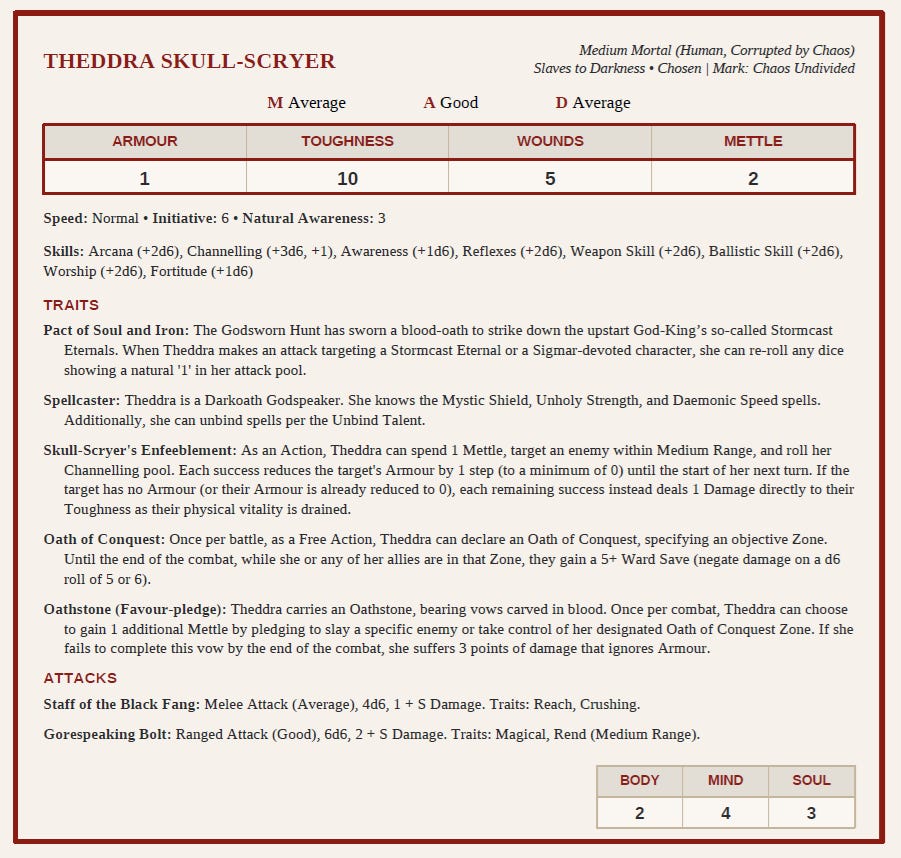
Theddra Skull-Scryer is a Chosen, and leader of the warband. Pact of Soul and Iron reflects her oath to hunt down the chosen and favored of Sigmar, allowing her to reroll 1’s in her attack pool.
Skull-Scryer’s Enfeeblement is her signature withering ensorcellment, and makes her a very nasty opponent against those who rely heavily on armor to shield them in battle, while Oath of Conquest is a powerful (if situational) ability she can use to bolster the defenses of her and her warband when they need to hold ground.
Finally, the Oathstone that she carries can give her extra Mettle once per battle- but at a cost in blood should she fail her vow. Note how this synergizes with her Oath of Conquest, and using both in tandem can really give her an edge.
As with Zarshia Bittersoul, I’ve streamlined her magical offense as an Attack (Gorespeaking Bolt), but this can easily be reverted to the more rule-compliant approach.
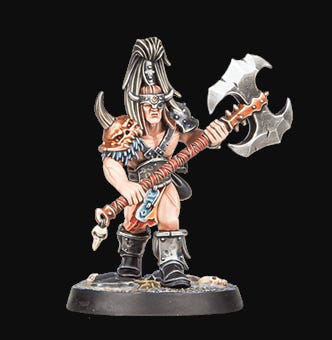
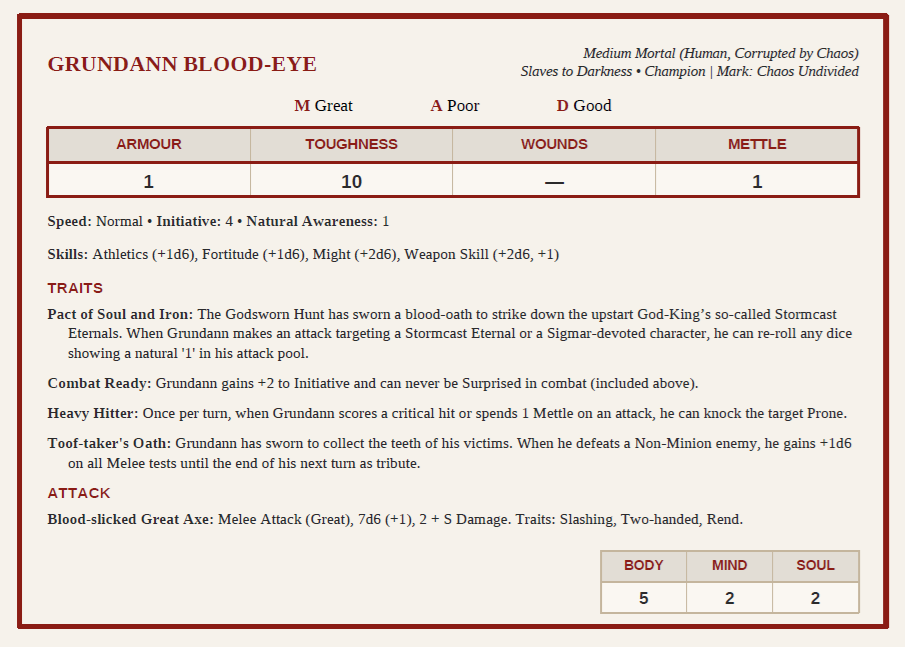
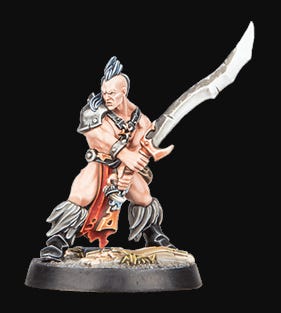
Grundann Blood-Eye is a warrior of the Godsworn Hunt armed with heavy blades. Grundann lost his eye to a blow from an Orruk Warboss, but claimed both his deed-name and the brutish creature’s war axe in the very same duel.
The official lore notes that Grundann wields “heavy blades,” but the model shows him brandishing a great axe so that’s how he’s been built. Toof-taker’s Oath is his secret weapon, upping his combat effectiveness whenever he takes down an opponent. When he lays down by the campfire at night, he dreams of chaining this ability across multiple turns.
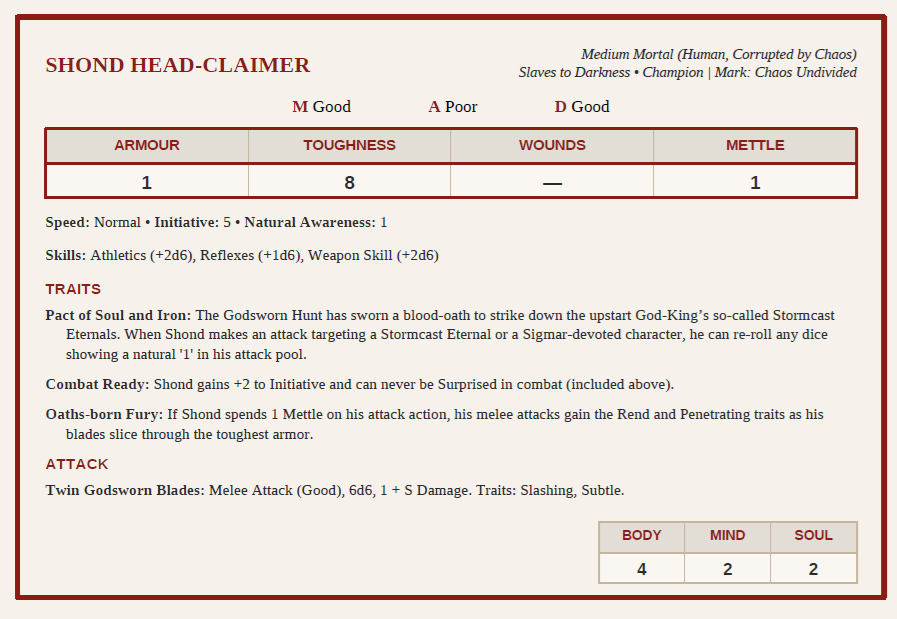
Shond Head-Claimer is a mountain of a man, quick to laugh and quicker still to strike the heads from those who test his patience. He lives for battle, blood-mead and glory. Shond dreads nothing, save that one day he will run out of worthy foes to slaughter.
Shond, too, has his abilities optimized for hunting down armored prey. Using this warband most effectively will require some tactical prioritization, as they’re somewhat ‘glass cannons’ due to their nimble, unarmored bodies. Trying to slog it out toe-to-toe heedless of their own vulnerabilities will see these Darkoath warriors falling quite short of their potential.
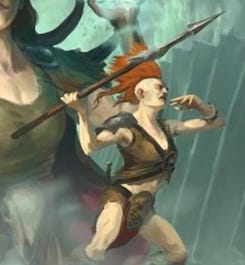
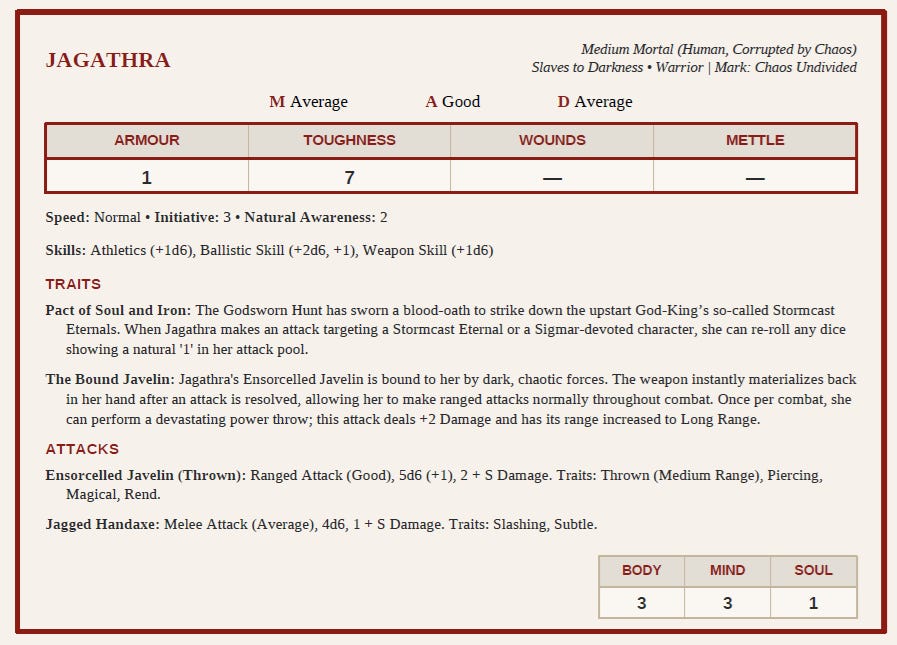
Jagathra is a javelin-wielding warrior of the Godsworn Hunt. Dark energies bind the javelin to Jagathra, returning it to her hand that it may kill again.
In a nod to her tabletop skirmishing abilities, Jagathra’s at her most dangerous when wielding The Bound Javelin. She not only can throw it multiple times in combat, but once per battle she can really lean in and give it an extra kick.
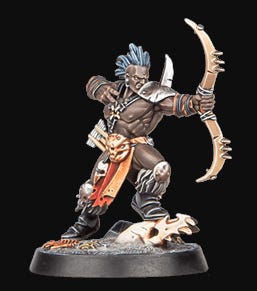
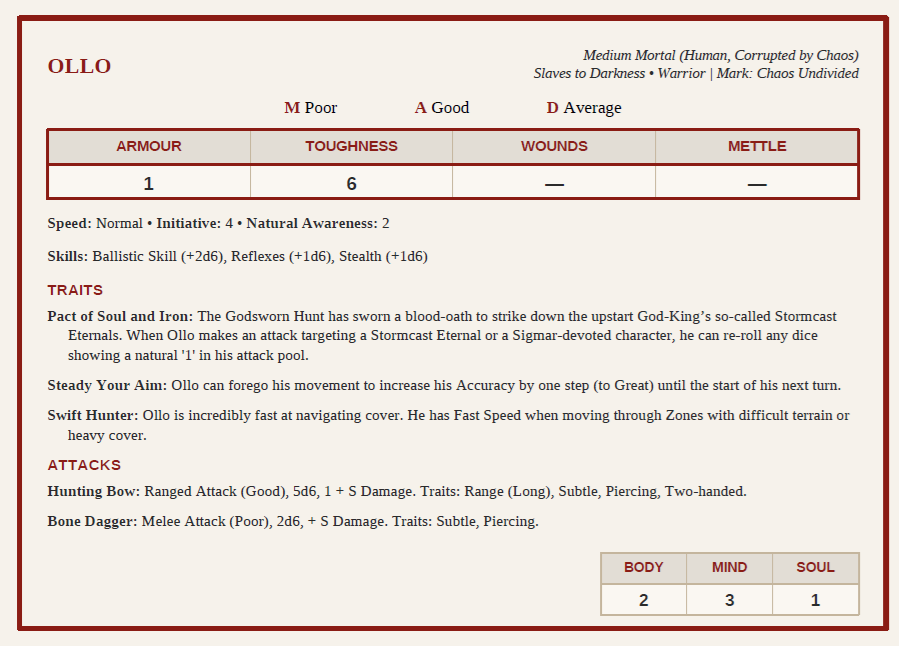
Ollo is the foremost beast trainer of the Tribe of the Black Fang. His hunting hounds have run down monstrous beasts of every description, driving them into the path of his pinpoint arrows.
Ollo’s Swift Hunter ability reflects his skirmishing, hit-and-run nature. He’s well-suited towards being an absolute pest if the warband comes across the party in difficult terrain, able to pepper his enemies with his bow while racing away once detected.
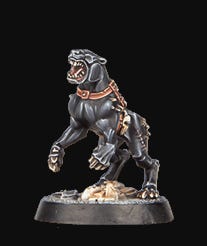
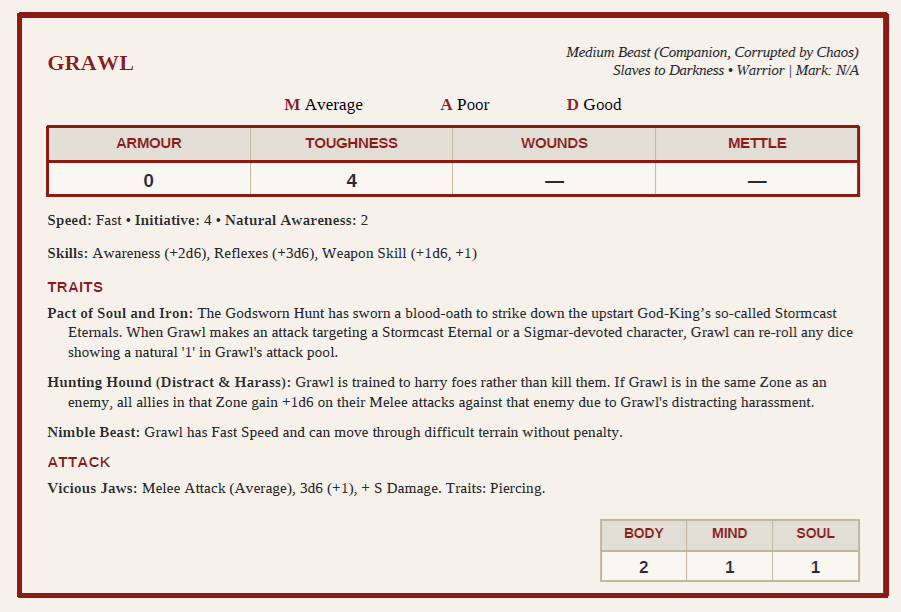
Grawl is a corrupted hound that accompanies beast trainer Ollo. Though savage in battle, Grawl follows its master’s commands with deadly precision
Where Ollo goes, Grawl is sure to follow. Every bit as Nimble as his trainer, parking Grawl where enemies are thickest will help the warband make bloody work of their foes.
How to Use the Godsworn Hunt
As I’ve noted in the character bios, the strength of this warband is tied to how the GM employs them rather than simple combat mastery. The Hunt is at its best when it can harry and wear down foes from a distance before going in for the kill. If you just throw them in from of a party as combat fodder they’re going to lose a lot of their effectiveness.
With Ollo and Jagathra able to harass from range, once the party has been suitably weakened the rest of the warband can trigger their ambush. Grawl is best used in the thick of it, buffing the rest of the Hunt in taking down a priority target. Shond and Grundann are your melee skirmishers, with Theddra lethally working the margins.
To integrate the Hunt into an adventure, it may be best to not let the party know about them at all. Whatever objective the players are seeking has also been the subject of one of Theddra’s visions from the Ruinous Powers. They may find themselves feeling watched, or their camp turned over and ruined while they’re away. As every step becomes dogged and pursued, the players begin to realize the nature of the threat arrayed against them and must find a way to turn the tables, hunting the hunters. This scenario works for both a Binding party as well as a Champions of Chaos one.
For a more role-playing scenario, play up Theddra’s mysticism. Perhaps they find a remote settlement that has come under her sway after the Hunt chased off a nearby threat from orruks, slowly being turned to worship of the dark gods by their ‘saviors.’ The party will need to investigate to find evidence of the true nature of the rituals Theddra’s been enacting, all the while taking pains to avoid crossing the grateful (but misguided) townsfolk.
I hope you’ve enjoyed reading the debut of RPG Conversions as much as I’ve enjoyed tinkering in the amazing toolbox that is Soulbound. These are just my visions for these characters in a way that pays homage to their tabletop origins while keeping them fun and easy to use in a campaign or adventure, and I’d love to hear yours. And if you’ve got a favorite warband you’d like to see appear in these pages, drop a comment below!
Yes, this overlaps with the Champion tier, but this “grey zone” is a judgment call area and depends in part on the lore role of the character in the warband. A leader’s lieutenant might slide up to Champion, while the party’s scout would likely remain a Warrior.
The excerpted lore notes her at different times as an Aspiring Champion and Chaos Champion, reflecting her growth in power. You can use either title, they are mechanically identical for the purposes of this conversion.
This is probably more feasible if the party is playing under the Champions of Chaos setting, where they may have opportunity to interact with the Ravagers peacefully (until the knives come out, at least).
Wow, this is awesome work! I want to run Soulbound now and add these guys to encounters.
I’ve been collecting some Underworlds warbands lately so Eyes of the Nine, Jaws of Itzl, and Mollog’s Mob are my current projects :D