
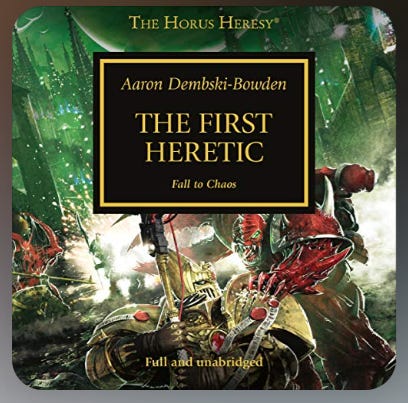
With much of my contemporary reading in service to writing reviews, audiobooks are my chance to “play catch-up” on the older catalogue of Black Library books. What you will find in this occasional feature is neither a full, formal book review nor a simple blurb, but rather something comfortably in between: impressions.
In a previous Audio Impressions, I went to bat for some of the Heresy’s less-loved books I’ve already come across (including James Swallow’s assassin-fueled heist-style adventure). For the Heresy’s “missteps,” I wondered, could it just be a matter of placement?
…the first five books of the Heresy are one hell of an act to follow. And in these, the Horus Heresy itself is the story. The tale of the Warmaster’s rise and fall is riveting fiction, and the overall success of the series is due in no small part to its incredible kickoff. Little surprise that Horus Rising, False Gods, Galaxy in Flames, The Flight of the Eisenstein, and Fulgrim have all been inducted into the Black Library Readers’ Hall of Fame. These tales cover monumental events, ones which resonate all the way through to the 41st millennium.
For other stories like Battle for the Abyss, though, the Horus Heresy is less the story and more the setting. In this Ben Counter’s novel might have suffered somewhat from heightened expectations, and I would put Nemesis right there alongside it. Readers were looking for the Sturm und Drang of the earlier books, and instead were getting some of the smaller-focus stories that helped make up the weave of the Heresy’s tapestry rather than being whole sections of it on their own.
Well, suffice it to say that The First Heretic does that hypothesis no disfavor, being perhaps the most consequential book (lore-wise) since the original trilogy. That’s not selling books like A Thousand Sons or Legion short, but rather a reflection that those stories- filled with the mythologies of the universe as they were- were largely contained to a single Legion.
And yes, while The First Heretic is inarguably the origin story of the Word Bearers, it is so much more than just that. Little surprise, then, that it is one of the twelve selections of the new Horus Heresy Saga reprint series.
The Story
In A Thousand Sons, Graham McNeill built up the Emperor’s case against Magnus, using the ruination of their homeworld Prospero that resulted as the book’s climactic event. Here, Aaron Dembski-Bowden instead puts the legion’s chastisement at the beginning. Both the Thousand Sons and Word Bearers were humbled for daring to look for meaning in the supernatural, and the wages reaped by each was damnation and destruction.
For the Word Bearers, who took great pride in bringing new human civilizations not only into Compliance with the Imperium but also in fostering their faith and spirituality, this arrived as the obliteration of Monarchia, crown city of Khur and pearl in the Legion’s crown. Its population, devoted in worship to the divinity of the Emperor of Mankind, given seven days to evacuate by the Ultramarines before the commencement of orbital bombardment.
As with the Council of Nikaea, the Emperor likes to issue his correctives in person, and Lorgar and his Legion are summoned to the ruins of Monarchia, there to kneel in its ashes as one. The Emperor upbraids Lorgar for wasting time on the hollow pursuit of faith rather than devoting that time to bringing more worlds into Compliance. The Legion, he notes, is one of the most populous in number but slowest at accomplishment and consequently, he has failed in the aims of the Crusade.
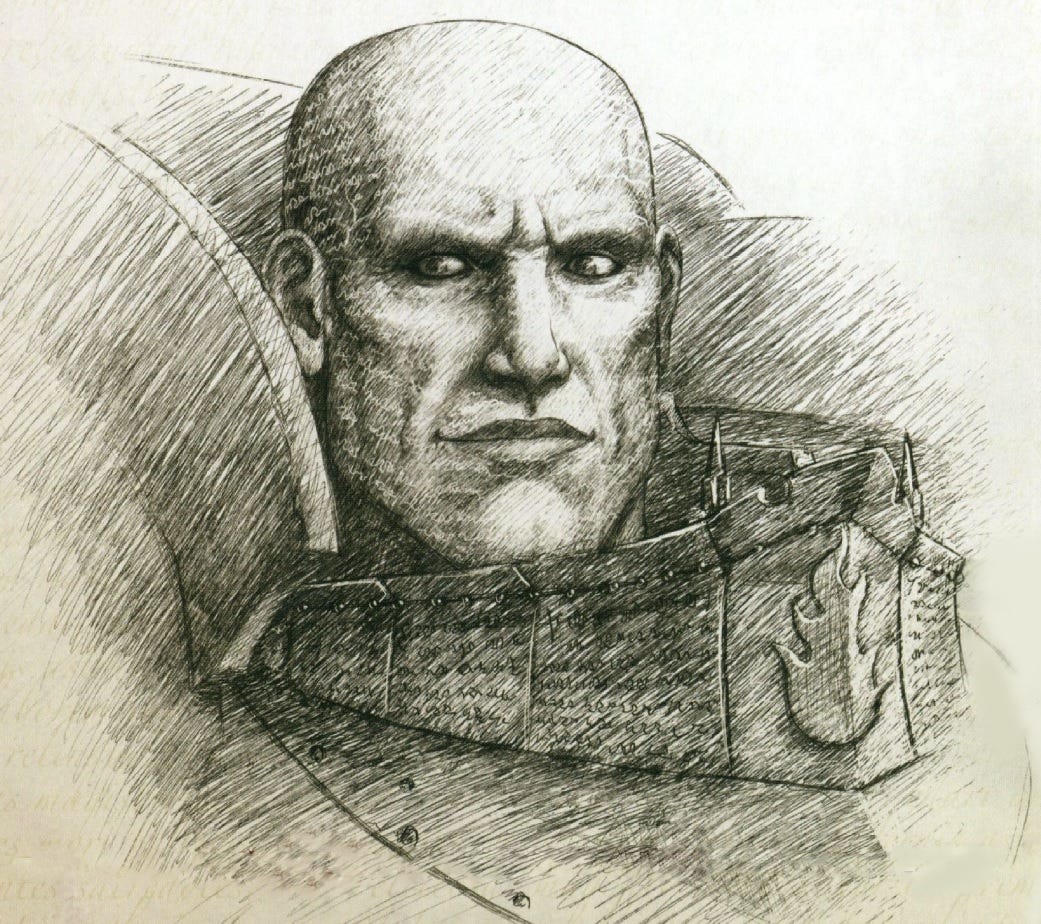
Chastened, Lorgar falls into deep depression. Two of his closest advisors, First Chaplain Erebus and Kor Phaeron, First Captain (and Lorgar’s foster father) convince him that while the Emperor may have indeed rejected his own divinity, other gods must surely exist elsewhere in the cosmos if they had but the courage and means to find them. Renewed in hope, Lorgar launches a pilgrimage under the guise of the Crusade. To all observing (including the host of Custodes the Emperor assigned to keep watch on the Word Bearers), it would look like Lorgar is merely bringing worlds into the Imperial bosom, as commanded.
But in realty, the search is on for a deeper, more primordial truth. And when they find it- and find it they do- the fate of Lorgar and his Legion will be forever changed.

Giving Voice
The book is read by Gareth Armstrong, who we last saw just two books ago in Graham McNeill’s A Thousand Sons and was given a full profile just before that for his work on Fallen Angels by Mike Lee. Here’s what I’ve observed from his work before:
But whereas some narrators will use accents to differentiate characters, Armstrong instead relies more on pitch and cadence- with much more mixed results. Zahariel and Nemiel in particular often sounded unimposing, at times more like a short-of-breath old man shouting rather than a towering transhuman warrior issuing decisive battlefield commands. I suspect Armstrong might be a better fit for books with a smaller cast of characters, and given the breadth of his body of work in the Heresy I’ll have a number of opportunities to put that theory to the test.
Armstrong here, too, delivers a solidly serviceable performance. His strongest feature still tends to be his default reading voice, which carries plenty of the dramatic gravitas needed for telling tales of this scope. How you feel about his Lorgar probably depends on how you feel about Lorgar to begin with. As with Magnus, Armstrong doesn’t try to imbue his Primarchs with deep or resonant vocalizations to elevate their stature. Rather, both sound surprisingly ordinary- though at least with Magnus, Armstrong gave him an air of certainty and confidence befitting The Smartest Person in the Room.
Lorgar, however, by contrast seemed small, almost weak at times. Sure he had his moments, such as when he stands up to Guilliman and Malcador in the ruins of Monarchia, but overall I found the character to be largely uninspiring. To be fair, much of that comes down to ADB’s portrayal- Armstrong, after all, only reads what’s in front of him- but more than once I found myself wondering how an entire Legion of Word Bearers chose to follow this guy into damnation1.
One stylistic choice Armstrong made was pitch-perfect: the sibilant whispering he adopted for the voice of the demon Raum, who sets up shop inside the body of Argel Tal. It’s perfect not only for the character, but also because it made it immediately clear which character was speaking- not always entirely evident otherwise given Armstrong’s lack of vocal differentiation.
Bits n’ Pieces (Spoilers)
This was an excellent book overall, and it’s not hard to see why it’s so highly rated by the Warhammer community. What’s really fascinating is how quickly Dembski-Bowden hit his stride in the Black Library. His debut novel, Cadian Blood, arrived in 2009 and was the year’s only inductee to the Black Library Readers’ Hall of Fame. 2010 brought with it not only The First Heretic, but Helsreach as well.
If I’m really picking nits, though, I don’t think ADB did full justice to the Word Bearers. I expected a lot more philosophical reasoning from this most spiritual of all Legions, a genuine depth to their faith that would slowly unravel before reforming into the path of damnation. For all Lorgar, Kor Phaeron, and Erebus trumpeted about the contribution faith has made to the evolution of mankind (which is one of their central tenets- that all human cultures have instinctively reached for something greater than themselves), never once did ADB note that one of the most significant is that it impels the individual to strive to be better than they are. The benefits of religion seemed limited to the external rather than the intrinsic.
I kept waiting for this, because I wanted to see how they squared that with the obvious evil of the so-called primordial truth. It never happened, as the characters tended to use faith as a synonym for religion. We get why the Word Bearers developed a spiritual void that throws their entire raison d’être into crisis. Far less clear is why the embrace of Chaos was so uncritical that it blew past the border of gullibility.
I’m probably expecting too much here from IP tie-in fiction. I gave David Annandale a lot of credit for even trying conversion dialogues in his recent Word Bearers novel Apostle (reviewed here), but those tended to fall well short of the mark as well. To date, the only book I’ve found that really seems to touch the essence of faith is Steven B. Fischer’s Broken Crusade- the first Warhammer book I ever reviewed for Tabletop Battles (then Goonhammer).
While this isn’t the first time we’ve heard about the “lost Primarchs” of the 2nd and 11th Legions- they’ve been at least hinted at before- that bit of lore gets a bit more fleshing out here. That’s a nice get for ADB who, don’t forget, is the new guy in the writer’s room at this point.
Lots of great little touches in the story throughout. You could have written an entire novella out of Incarnadine, the Conqueror-class battle-automata belonging to the Legio Cybernetica that was adopted by the Word Bearers. A sequence where his handler, Xi-Nu 73, tries to figure out how his brain was spontaneously rewiring itself was almost criminally underdeveloped- a fantastic idea that’s given a brief mention and never expanded upon.
Finally, while ADB is perhaps best-known for his humanizing treatment of the Night Lords, he truly excels at bringing out the human character in characters that may otherwise be harder to redeem. He makes little secret that Argel Tal will ultimately betray his friend, Aquillon of the Custodes, and he weaves in the tension throughout the latter half of the book to terrific effect. For all you know it’s coming, it’s still heartbreaking when it happens.
I’m continuing on with the Heresy, with Abnett’s Prospero Burns already underway. With a road trip back to Houston this week (16 hours, one-way), I’ll have plenty of time for listening. Thanks for reading!
Not the entire Legion, to be fair. The book does touch on the fact that Lorgar had to purge those whose buy-in wasn’t complete.
This is still to this day one of the best books I have read about 40k.