
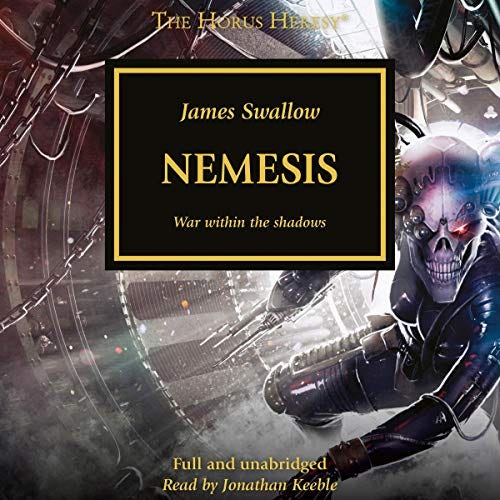
With much of my contemporary reading in service to writing reviews, audiobooks are my chance to “play catch-up” on the older catalogue of Black Library books. What you will find in this occasional feature is neither a full, formal book review nor a simple blurb, but rather something comfortably in between: impressions.
It’s no secret that some books of the Horus Heresy are more popular than others. After all, in a series as sprawling and epic as this one- fifty-four mainline books before you arrive at the Siege of Terra- not every book is going to appeal to every reader.
Thirteen books in and I’ve already crossed a few. Using Goodreads ratings as a barometer for community sentiment, most of these early Heresy novels clock in reliably North of a 4.00 score. A few do not, and the list of them isn’t entirely unexpected:
Descent of Angels, by Mitchel Scanlon (3.63)
Battle for the Abyss, by Ben Counter (3.42)
Mechanicum, by Graham McNeill (3.89)
Fallen Angels, by Mike Lee (3.76)
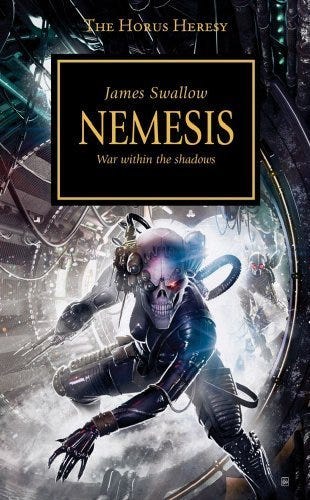
And now, we can add James Swallow’s Nemesis, with its 3.72 score. What’s wrong with these books?
A Team-Building Exercise
My wife and I had another trip to MD Anderson in Houston this past week, and this time we chose to drive instead of fly. That meant I had plenty of time for audiobook enjoyment, and I devoured Nemesis in record time.
I loved it.
It’s got one hell of a premise. Imagine a target so high-value, so nearly unkillable that the only way you have a shot of taking it out is to do something that has never been done before in the history of the Officio Assassinorum: sending a kill team of six assassins- one from each specialty (or clade).
Much of the book’s early direction follows the “building a team” blueprint made famous in Kurosawa’s 1954 masterpiece, Seven Samurai, and widely used in films such as Ocean’s Eleven and The Avengers. You almost certainly know the structure: a leader must assemble a team, and they move from one scene to the next where their target gets to show off their skills before being recruited, the team getting bigger with every stop.
One of the benefits to that approach is that by giving each character a scene to show off their particular set of skills, even readers who might now know anything about the Officio Assassinorum’s clades will have a much deeper understanding by the time they’re ready to move on their target.
Oh, speaking of, that high-value, nearly unkillable target that’s forced the clades to work together? His name is Horus Lupercal.
The Story
Swallow does amazing work weaving together different genre narratives into a firecracker of a story here.
As mentioned about, you’ve got the first arc which is “putting the team together,” with Captain-General Constantin Valdor tasked with getting the ball rolling. Then you’ve got a (seemingly) unrelated thread that plays out like a police procedural, with a serial killer on the loose on the planet Iesta Veracrux. Then it all comes together in the assassination scheme which more than once reminded me of a gripping Cold War tale with the target in the crosshairs being the Soviet Premier- untouchable, unreachable, almost certain to fail… but maybe.
Of course, it’s no spoiler to note that no Horus Lupercals were harmed in the making of this novel- but even knowing that I was still on the edge of my seat when the plan kicked off.
Always Look on the Bright Side of Life
So what is it about Nemesis that readers haven’t seemed to click with? I’m increasingly of the mind that the culprit is- at least in part- the difference between story and setting.
I first noticed this with Battle for the Abyss, the lowest-rated Horus Heresy book on Goodreads I’ve read thus far. Battle gets a fair share of hate, seen by many as inconsequential bolter porn, but I think there’s a case to be made in its defense.
For one thing, the first five books of the Heresy are one hell of an act to follow. And in these, the Horus Heresy itself is the story. The tale of the Warmaster’s rise and fall is riveting fiction, and the overall success of the series is due in no small part to its incredible kickoff. Little surprise that Horus Rising, False Gods, Galaxy in Flames, The Flight of the Eisenstein, and Fulgrim have all been inducted into the Black Library Readers’ Hall of Fame. These tales cover monumental events, ones which resonate all the way through to the 41st millennium.
For other stories like Battle for the Abyss, though, the Horus Heresy is less the story and more the setting. In this Ben Counter’s novel might have suffered somewhat from heightened expectations, and I would put Nemesis right there alongside it. Readers were looking for the Sturm und Drang of the earlier books, and instead were getting some of the smaller-focus stories that helped make up the weave of the Heresy’s tapestry rather than being whole sections of it on their own.
“For a book that, at the time, was not intended to link to anything else,” noted Horus Heresy editor Laurie Goulding in the hardcover edition’s afterword, “Battle for the Abyss showed how the hubris or heroism of a few relatively unknown characters could affect the future of the galaxy, for better or worse.”

Giving Voice
Of all the many voices in the Black Library’s stable of talents, Jonthan Keeble is inarguably one of the best. My first-ever Warhammer audio story- one I’d tried on a lark- was The Last Church, by Graham McNeill. I remember being absolutely riveted not only by its story and structure- it’s essentially one long dialogue between two people- but at the incredible sense of atmosphere in the voice acting. Like I was there, fully present and watching a conversation between two people, rather than hearing a story being read to me like my mother’s old bedtime stories.
Keeble has had bit parts in film and television (notably the 2022 Bill Nighy film Living, and an episode of a Doctor Who spinoff), but it’s in voice that his career has truly blossomed. From video games (Star Wars: The Old Republic, Elden Ring) to animations (Warhammer: Angels of Death, Strange Hill High) to an impressive catalgoue of audiobooks, it’s not difficult to see why he’s been a Voice Arts Award winner (in 2016, for Paul McCartney: The Life by Philip Norman)
If The Last Church intrigued me, making me look twice at a format I’d until then entirely disregarded, his narration of Aaron Dembski-Bowden’s Helsreach is responsible- more than anything else- for showing me what the medium was capable of. More than just an incredible story, Keeble brought the different characters to life- with Steel Legion Storm Trooper Andrej Valatok being an exceptional, standout performance that stole every scene he was in.
Soon after I landed on Trollslayer, William King’s classic novel that first featured Gotrek and Felix. Keeble delighted here again, and his Gotrek has gone down in my head as the character’s definitive voice.
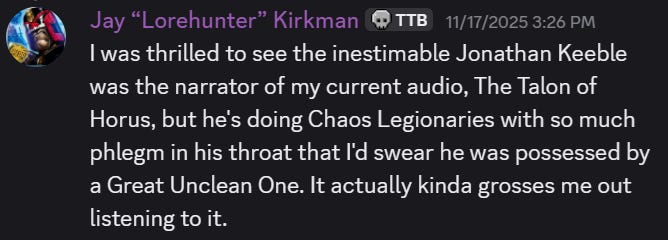
Of course, that isn’t to say that in some ways he doesn’t fly perhaps a little too close to the sun. I got a good chuckle from a comment I came across in the Black Library subreddit this week1:

Right there with you, friend.
Bits n’ Pieces (Possible Spoilers)
Nemesis was the first book in the Heresy that really got down to what normal, everyday life might have looked like in the Imperium as the tides of history came crashing in. Not just a few token mortals, not a bunch of remembrancers, but people who get up in the morning and go to work and start hearing news and rumors though the fog of war about what’s happening in the galaxy. Swallow had me riveted with this approach, even if it didn’t take up a lot of word count in the book overall. For example, cops gossiping about rumors of certain planets going silent after declaring for the Warmaster is a great way to add a sinister sense of dread without ever once having to add a scene with any traitor Astartes.
I thought Spear was a terrific villain, internally messy and chaotic as I think many devotees of Chaos must be (whether it’s because of the influence of Chaos, or just he nature of those who would seek it out).
I’d credit the poster, but they’re a deleted account. Here’s the thread, though.