
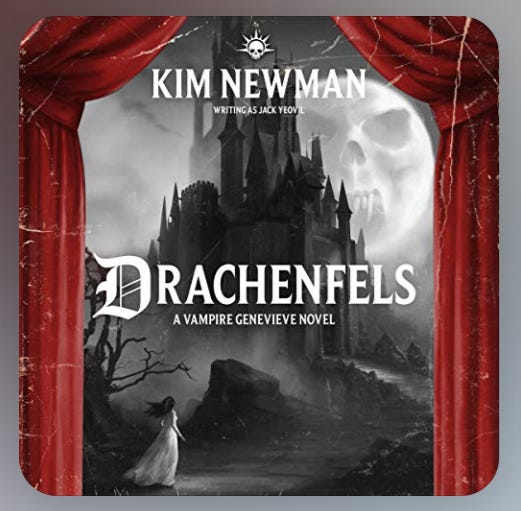
With much of my contemporary reading in service to writing reviews, audiobooks are my chance to “play catch-up” on the older catalogue of Black Library books. What you will find in this occasional feature is neither a full, formal book review nor a simple blurb, but rather something comfortably in between: impressions.
Subscribers note: You are receiving this email since you’ve subscribed to the Black Library Features segment of the Warhammer Wordforge. You can easily update your notification preferences here at any time. Thanks for reading!
The first-ever Class considered for induction into the Black Library Readers’ Hall of Fame represented the earliest efforts by Games Workshop to expand their properties into the realm of fiction. There was no Black Library then, not as we know it today- that wouldn’t come into being until 1997. But that doesn’t mean that there weren’t foundational works being produced, and today we’ll be looking at one of the first three books ever to be inducted into the Hall: Drachenfels, by Kim Newman (writing as Jack Yeovil).
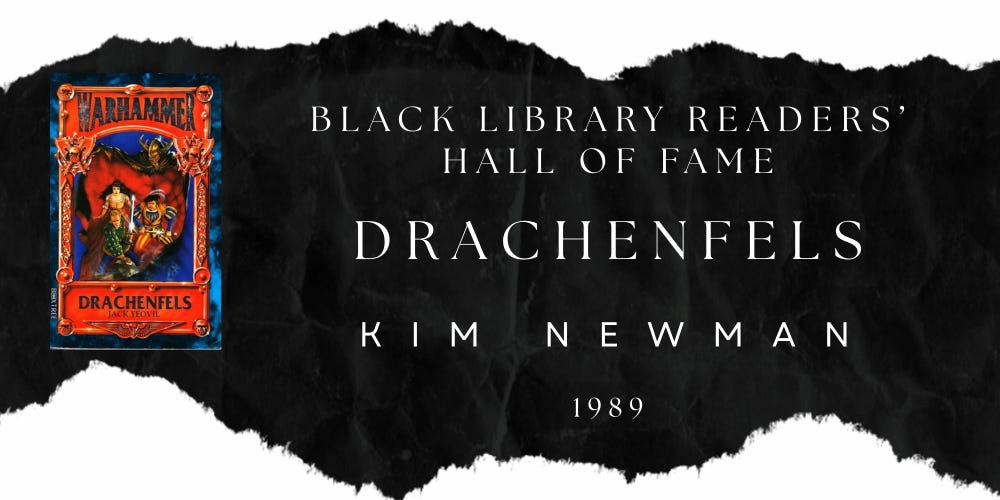
It was inducted as part of the Class of 1989-98, alongside two legendary books by Ian Watson (Inquisitor and Space Marine). Warhammer fiction then was something of a Wild West, given the relative infancy of the properties and the lack of established lore (Warhammer Fantasy Battles debuted in 1983, Rogue Trader- what we now know as Warhammer 40,000- followed four years later). To get its literary arm off the ground, Games Workshop turned to established genre writers to work their magic inside their new sandboxes.
I’ve written before about Ian Watson’s somewhat gonzo legacy as part of my 40K History of the Black Library series (originally on Tabletop Battles, now continuing here on the Wordforge). But I’d long been curious about how the Fantasy side of that era held up. To my delight, I found that there was an audio edition of Drachenfels (and indeed, a four-book Collection!), so in I went!
The Story
I went into Drachenfels completely cold, with no knowledge of the story, the character, or really much of anything in the Fantasy1 canon. And at first, it unfolded like a standard fantasy novel: a group of heroes. A forbidding and sinister castle. An ancient evil. One by one the heroes succumb to the many traps and perils, bravely battling ever onward towards the inevitable, triumphant confrontation in the heart of the castle.
And then, everything changes.
Drachenfels, you see, isn’t about the story of the heroes vanquishing Constant Drachenfels. It’s the story about the story of the heroes vanquishing Constant Drachenfels. It’s now two decades later, and the hero who struck the fatal blow against the sorcerer, Oswald von Königswald, wants to commission a great play commemorating the anniversary of the event. He retains one of the great playwrights of the era, Detlef Sierck2, and flings his coffers wide for a no-expense-spared production that will be staged in the original Castle Drachenfels.
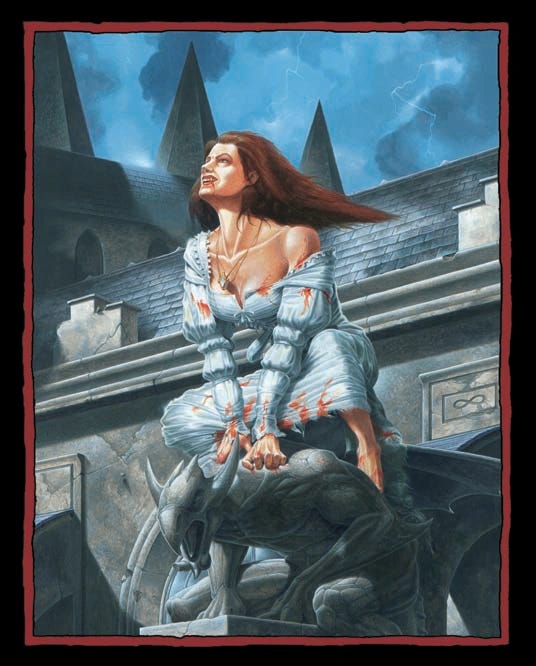
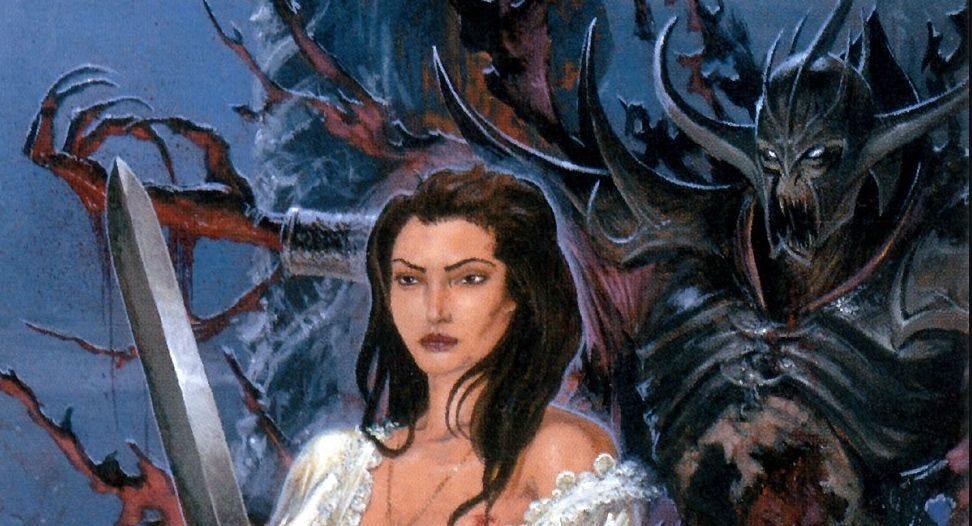
Sierck brings together the remaining, surviving heroes of the original event, a small group which includes the vampire Geneviève Dieudonné3. He begins work on the play and production immediately, diving in to what he intends to be his magnum opus. The sets are build and actors auditioned, but as the play moves towards its opening night, strange misfortunes begin to plague the production.
And then the murders begin.
von Königswald, Sierck, and Geneviève must uncover what sinister forces seem to be trying to derail their production, while bravely trying to keep the whole thing from derailing and ruining Sierck’s reputation. When the curtains go up on opening night, will there even be an audience? Or even a production?

The Author
Drachenfels was the perfect debut novel for Newman, combining two of his great loves: horror and theatre. Mainly active in the Black Library between 1989 and 19934, he’s had a much more substantial body of work outside of it in both fiction and non-fiction.
The same year Drachenfels released, Newman won the first of his two Bram Stoker Awards, co-writing Horror: 100 Best Books with Stephen Jones. He’s also been awarded a BSFA Award (for Short Fiction, in 1990) and in 1994 his novel Anno Dracula earned him an International Horror Guild Award5.
His latest novel, this year’s Model, Actress, Whatever6 is a satirical blend of superhero and alternative reality elements (where the Beatles never broke up), and he’s also an established film critic and posts something vampire-related every day on social media.

The Voice
Drachenfels is narrated by Antonia Beamish, who has also provided narration for a number of other Warhammer stories including Lelith Hesperax: Queen of Knives by Mike Brooks and Chris Thursten’s Abraxia: Spear of the Everchosen. In addition to a small number of short film credits7, she provided voice talent for Divinity: Original Sin and Divinity: Original Sin II.
When assessing the voice production for an audiobook, I typically look at two things in particular. First, how is their general narration voice overall? Is the book enjoyable to listen to? Then second, how is their range of characters? Are they able to give each their own, distinctive voice so that they stand out in contrast to one another?
In both, I found Beamish’s work here to be excellent. The story was a very easy listen, and her range was terrific. Beamish reminded me of Jonathan Keeble in her willingness to employ not just tonal shifts in her voice, but the adoption of different accents to distinguish her characters. Tonal shifts when the narrator is crossing genders can be a bit fraught, but again as with Keeble I found Beamish’s masculine voices worked.
If there was one questionable choice, it was her adoption of a French accent for Detlef Sierck. Sierck, from Nuln, would likely not have sounded like a Bretonnian; that accent would more rightly have gone to Geneviève (which it did not). But this is the kind of background information that any narrator would probably be unaware of in the absence of a “lore primer” from Games Workshop, so it’s no mark against Beamish.
Similarly, I chuckled for a moment when she mispronounced the “lead” in lead soldier, giving it a long -e sound (as in “leader”) rather than the short one (as in the metal). We can’t expect everyone to have a gaming background, right?
My Impressions
I enjoyed this book far more than I expected to. Newman’s focus on a theatrical production was delightful, an unusual setting that his background was able to inform and flesh out with terrific detail. I wouldn’t have minded a more generic fantasy tale, but I give Newman a ton of credit for taking the unexpected route for his first Warhammer novel and delivering something truly special.
Beyond just the story itself, Newman’s writing was delightful. His Geneviève is the kind of lush, sensual creature you’d find in an Anne Rice story, but rather than making her some decadent aristocrat she’s very much a creature of the world she inhabits. Her longevity doesn’t imbue her with listless stagnation; rather, Newman’s Geneviève is a barmaid when we first encounter her, and has lived all sorts of lives in her time.
His characterization for the others is similarly terrific. We first find playwright Sierck in a debtor’s prison, for instance, with Newman using the amount each of Sierck’s cellmates’ debt to introduce them into the narrative. “Money was like the fabled warpstone,” Sierck later notes, “the more contact you had with the stuff, the less like a human being you became.”
Finally, Newman’s pacing keeps the story moving forward laden with suspense. Having recently enjoyed Dan Abnett’s Hive (reviewed here), I enjoyed how Newman too took an approach that avoids driving to the heart of the story. Instead it takes its time, circling around the edges while moving ever more closely inward.
Drachenfels is a story to be savored. And this audiobook is the perfect vessel for doing so.
Bits n’ Pieces (Possible Spoilers)
In most heroic fantasy stories, the heroes storm the castle, win the day, and live more or less happily ever after. Not here. I loved how the initial foray into the Castle Drachefels that opens the tale leaves an indelible trauma on each of those that survived it. They emerge from the ordeal not triumphant, but forever damaged. Somehow, that feels a lot more true to life. After all, you’ve just watched your friends and companions getting horrifically killed. Who’s popping champagne? And by advancing the tale two decades after the event, Newman has plenty of space to work with to illustrate the lingering trauma that never fully goes away.
Towards that end, there’s a fascinating kind of resonance that Newman skillfully weaves into the story when the heroes return, two decades later, to help stage the play. Seeing those places for the first time in two decades, imagine how that would feel. There’s a terrific scene where one of the old heroes is half-drunk carousing with a woman, suddenly realizing that he’s in the very corridor where he and the party had been savagely attacked by living gargoyles twenty years ago.
While billed as a Vampire Geneviève novel, there was surprisingly less of her than I’d have expected. She’s present, she’s important, but as with any good theatre production it’s the cast that shines.
Finally, a quote where this story’s love of the theatre shined through… One of the original party (Rudi) is regaling the play’s cast and crew with stories of his adventuring days over a pot of gin:
The more he spoke of the days of plunder and glory and adventure, the more Rudi came to know that this was the real truth of the matter. What had happened didn’t matter any longer. Erzbet was dead, Poelzig was dead, the boy was dead, his brains paste on the floor – the times were dead. But the stories lived. Detlef understood that, with his histories and his dramas. And Oswald too, with his play that would pass all their names down to future generations. Rudi the dirty murderer, Rudi who howled in grief and fear as he smashed in the skull of an innocent child, would be forgotten. Rudi the bandit king, Rudi the stalwart ally of brave Oswald, would be remembered as long as there were stages to dress and actors to walk upon them.
I came to Drachenfels expecting something relatively by-the-numbers, and instead left with one of the best Warhammer fantasy stories I’ve read. Looking forward to the next installment, Geneviève Undead!
I’ve begun exploring the universe through the audiobooks, but at time of writing the Old World is very much the Undiscovered Country for me. It’s a wonderful place to be, to be aware of the joy of exploring things for the first time, and I’ve taken full advantage.
A name that I’d already heard a number of times in the Gotrek & Felix stories, to my delight.
With my D&D background I instinctively assumed the worst about vampires here, but Warhammer’s vampires are a bit different. There’s even a small amount of social tolerance of their condition. The good news is, Newman does a terrific job of explaining what you need to know here.
In 2002, two of his short stories saw print for the first time in the Silver Nails anthology. Whether that represented later work, or just work from his active period that just hadn’t been published at the time is unknown.
Here’s one for the pub quiz crowd. Anno Dracula was an alternate-history vampire story set in 19th-century London, featuring Jack the Ripper as a kind of vampire hunter. Amongst the book’s characters is a French vampire named- wait for it- Geneviève Dieudonné.
I link to Amazon for convenience, but always recommend first trying your local, independent bookseller.
Including 1998’s A Day Without a Mexican, which was I’d seen in a theater back then and was surprised to learn. Funny when different worlds intersect…
This as been on my want to read list, but keeps getting pushed back. I really want to get to the audio now soon.