
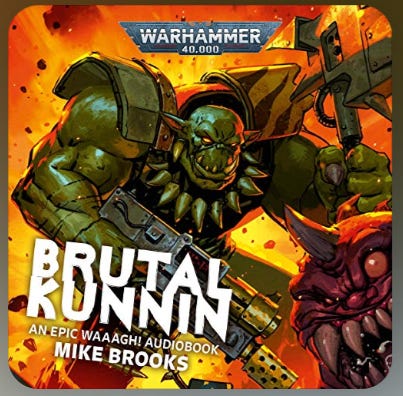
While Denny Flowers has probably done the most heavy lifting in my year-long change of heart regarding Ork stories, first blood definitely went to Mike Brooks, author of today’s audiobook Brutal Kunnin’.
It’s not that I hated tales featuring the greenskins, nor stories with a more lighthearted tone. After all, I’m a big fan of Sandy Mitchell’s Ciaphas Cain tales, even if they have become increasingly derivative the further into the series I’ve gone1. But while I think Orks have made terrific villains when they’re faceless and savage, this particular brand of humor has struggled to land for me2.
This started to change when I read Brooks’s Painboyz, the opening story of the terrific Blood of the Imperium anthology (review). I found this one to be side-splittingly funny, with an easy humor that never felt forced for laughs.
As I read more such stories, first Grotsnik: Da Mad Dok (review) then Ghazhgkull Thraka: Warlord of Warlords (review), I found my original antipathy rapidly thawing, and by the time I finished Justin Woolley’s Da Freebooterz Code (review) I had to admint I was all in. The conversion was complete.
Of course, there’s a lot of classic Ork tales out there I’ve never given much attention to, and it seemed a good time to mix one of them into my audiobook rotation.
The Story
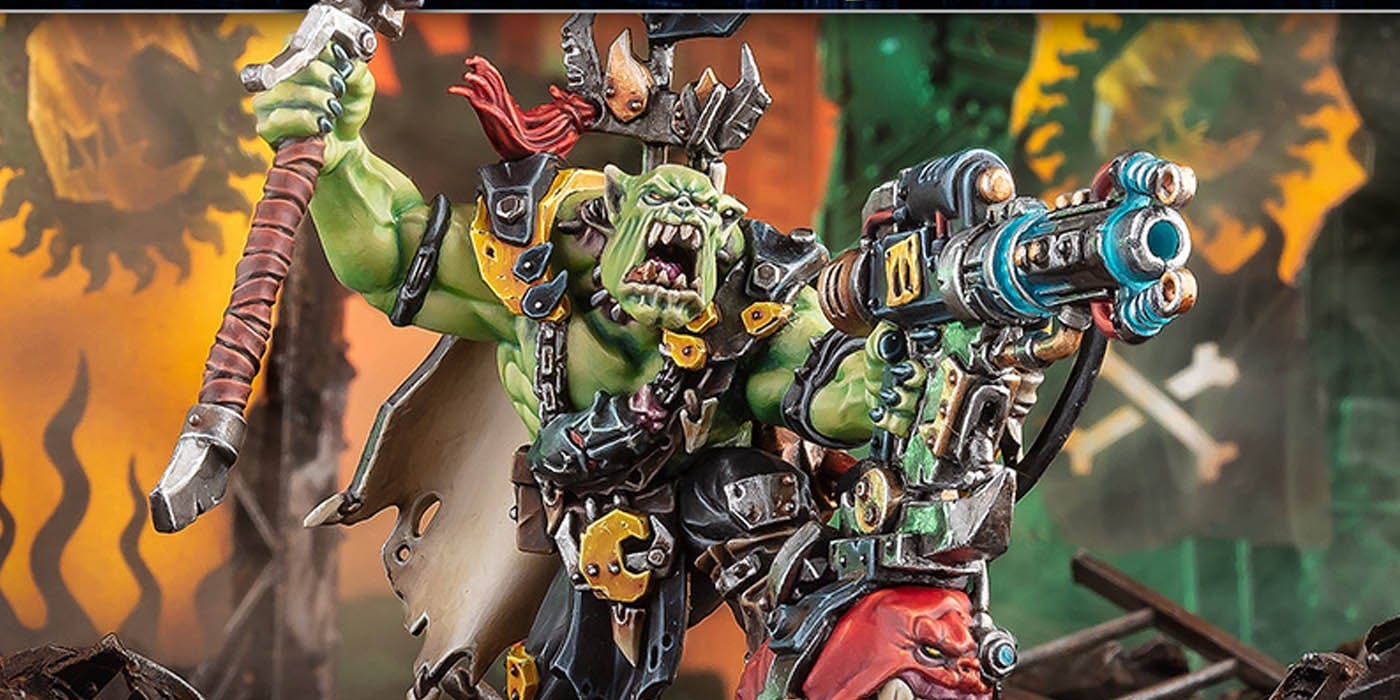
Brutal Kunnin’ tells the story of Ufthak Blackheart’s plundering of an Adeptus Mechanicus forge world, Hephaesto, as part of the Tekwaaagh! led by his Warboss, Da Meklord. Hepahesto is a planet made mostly of metal and tech, an irresistible prize to the covetous greenskins.
Of course, what one Ork wants another Ork wants too, and in this case that ‘other Ork’ is the Freebooter, Kaptin Badrukk. He warps in with his Flash Gitz with eyes on the same prize, and the two Ork leaders manage to set aside their differences and agree to a friendly competition to see who can loot the most goods.
Blackheart, a newly-elevated Nob of the Bad Moons, sets out to make a name for himself and outdo the hated Flash Gitz of Dadrukk. Backed by his second, Mogrot Redtoof, as well as gretchin Nizkwik and squig named Princess, the race is on.
Meanwhile, things are in a state of disarray with the planet’s AdMech squabbling leaders. The Tech-Priest Dominus seems to downplay the threat of the primitive Orks, while Lexico Arcanus Zaefa Varaz, recognizing the threat to the planet, races to back up their most valuable data and get it safely off-planet. Things go from bad to worse when they find there’s a Warpsmith of the Iron Warriors at work on the planet- and that their own Forge Lord is in league with him to animate a massive dameon engine.
All of these elements bounce and carom off of one another over the course of the tale, one which sees Blackhawk and his merry band- though that mix of random absurdity and dumb luck so particular to Orkish acts of derring-do- go from adventure to misadventure and back again in their efforts to get one over on Captain Badrukk and gain Da Meklord’s favor.
The Voice
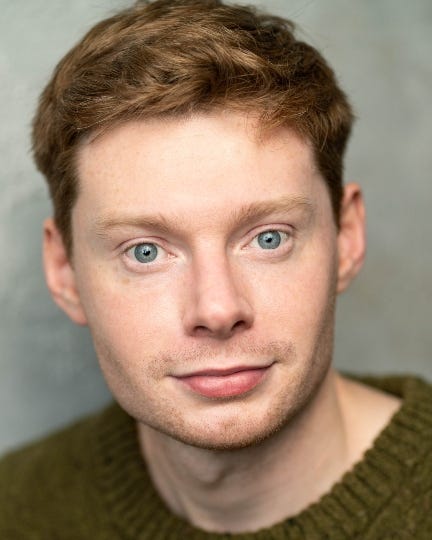
Brutal Kunnin’ was narrated by Tom Allenby, one of three audiobooks he’s recorded for Warhammer with the other two being Mitchel Scanlon’s Fifteen Hours and some of the stories in Death and Duty: An Astra Militarum Anthology (review)3.
Interestingly, he’s also lent his voice to the Warhammer 40,000: Darktide game as a Groaner, one of the hive’s many enemies. I’d imagine that’s a pretty bit part, but for Brutal Kunnin’ Allenby threw himself in with reckless abandon.
It’s difficult to imagine what some of the more patrician and elocutionary narrators like Jonathan Keeble or Gareth Armstrong might make of a book like this, filled to the brim with a gaggle of bombastic, larger-than-life soccer-hooligan Orks. This makes Allenby the man for the moment, and while the execution was a little uneven- I found myself more than once wishing the presentation came with subtitles, particularly for the voicing of Mogrot Redtoof- it lent the story no shortage of kinetic enthusiasm that matched its energy perfectly.
Thoughts
One of the things I’ve enjoyed about the Ork books written by Denny Flowers is that he doesn’t rely on the humor to make the book, but rather makes it just one of several well-blended ingredients. With his Mad Dok Grotsnik, there’s a certain unsettling sense of menace that is woven into the character, like there’s something more to him than what you can see, and whatever that is is surely worse. Da Mad Dok, put simply, creeps me out- and that’s a real credit to the writer.
With Brooks, there’s a different element at work here, but one no less effective. There you’d be, listening to this zany, absurd story of Orks doing Ork things, and then you’d get a passage like this once it flashed back the point of view of the Adeptus Mechanicus:
Heroism was not the way of the Adeptus Mechanicus. Not for them the glory-seeking exploits of the Adeptus Astartes, the martyrdom of the Adepta Sororitas, or the emotionally charged illogicism of the Astra Militarum; nor even the honour-bound charges of the Knightly Houses. What other branches of the Imperium might call heroism, the Adeptus Mechanicus simply recognised as an individual or individuals fulfilling a role to achieve a specific goal or improve the overall fighting efficiency of the force to which they were attached. In some cases, the supposedly heroic act was notable simply because the individual’s peers had failed to fulfil those duties, which would have been equally expected of them.
Mitranda’s choice was not based on a desire to achieve a heroic end, versus a desire to continue existing. It simply came down to statistics: which course of action would serve the forge world better?
Or here, a moment’s lingering on the Iron Warrior Warpsmith:
The sparks of life on this planet were so feeble and sparse, that was the problem.
Gavrak Daelin’s great work, in common with all great works, required many things for it to be truly complete. He’d been able to source the vast majority of those things, either through simple ingenuity, or through the connections of his ‘patron’. However, there were some things for which there were no shortcuts, no easy solutions.
Life was one of them.
Life was the key to so much. Gavrak Daelin held life in no particularly high regard – indeed, he was contemptuous of it in all but himself – but there was no doubting the essential nature of it. Life was a currency, a key that could unlock doors which would otherwise remain firmly closed. Life could be bartered and traded – although as Gavrak Daelin knew well, only the most foolish or the most desperate bartered and traded with their own – and bring the savvy trader tools and opportunities most rare and exquisite.
Brooks can write, and moments like these sprinkled throughout the tale not only gave us some pacing breaks from the Orks, but themselves made the story that much richer. Indeed, the non-Orks were every bit as interesting and entertaining as the Orks were in their own way, from diving into lore on the construction of daemon engines to the very understated humor of the tech priests (“please refer to my most recent noospheric upload”, which, if you change that to “email” is exactly the kind of petty, corporate- office barb it sounds like).
Up next in this series will be Da Big Dakka, which will be interesting in that Harry Myers steps in for narrative duties. I’ve heard complaints that a change in voice can really throw off listeners (most notably in the Gaunt’s Ghosts series), so I may let this one fade in the memory a bit so I can give Harry a fair go.
Until then, keep on listening!
I explored this in greater depth in my recent review of the Illustrated and Annotated Edition of For the Emperor, here.
Fairly or unfairly, I hold up Guy Haley’s Evil Sun Rising as the exemplar of what I don’t really love about it, as reviewed here. I always keep in mind that not every book is for every person, and there could just as likely be someone out there who thinks this one’s terrific! It’s just not me.
I’ll never shame a man for honest work, but I did chuckle to see that most of Allenby’s audiobook narration has been in service of children’s books like The Badger Can’t Sleep and Attack of the Cybugs. A gig’s a gig after all, and the juxtaposition of grimdark alongside these other contributions was kind of wild.