
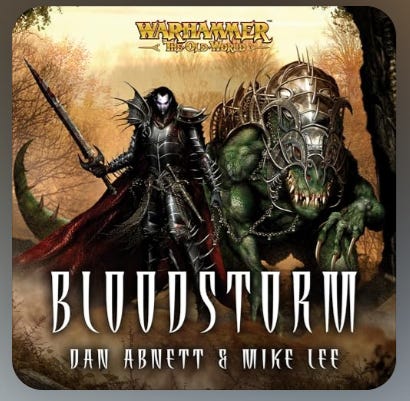
With much of my contemporary reading in service to writing reviews, audiobooks are my chance to “play catch-up” on the older catalogue of Black Library books. What you will find in this occasional feature is neither a full, formal book review nor a simple blurb, but rather something comfortably in between: impressions.
Subscribers note: You are receiving this email since you’ve subscribed to the Black Library Features segment of the Warhammer Wordforge. You can easily update your notification preferences here at any time. Thanks for reading!
I genuinely enjoyed my last visit with Malus Darkblade, in part to the terrific story from Dan Abnett and Mike Lee but also in no small part to the masterful narration by Andrew James Spooner. As I wrote in my review of The Daemon’s Curse, while Spooner might not have the greatest character range amongst the Black Library’s stable of voice talent, he absolutely nails the druchii highborn, Malus. It’s one of the most delightful audiobooks I’ve listened to since jumping in on the format.
Originally published in 2005, Bloodstorm is the second book of the Malus series and unfortunately, the last one (at time of writing) to get the audiobook treatment. If you’re loving the Malus/Spooner dynamic, this is your final installment.
The Story
The Daemon’s Curse in many ways was a kind of origin story for Malus. It didn’t go back to his early life, but rather told the tale of how he comes to get possessed by a daemon- one of the character’s primary characteristics from the comic series. Indeed, the possession doesn’t even come until late in the book, making Bloodstorm the first full novel adventure we get seeing this ‘partnership’ in play.
Darkblade is compelled by his domineering passenger, Tz'arkan, to find a series of five artifacts to help free him, otherwise he forfeits his soul. To make things worse, he only has one year to accomplish this. With the first artifact secured at the end of The Daemon’s Curse, Malus must now take to the seas to secure the second: the Idol of Kolkuth.
After managing to secure a Writ of Iron from the Drachau (ruler) of the city of Hag Graef- a legal document cast in actual iron that grants him the Drachau’s authority, but also a murderous punishment should he fail in its appointed task- he reunites with three of his siblings to destroy the seafaring Nurgle-cultists known as the Skinriders and claim the Idol they hold.
Bits n’ Pieces (Light Spoilers)
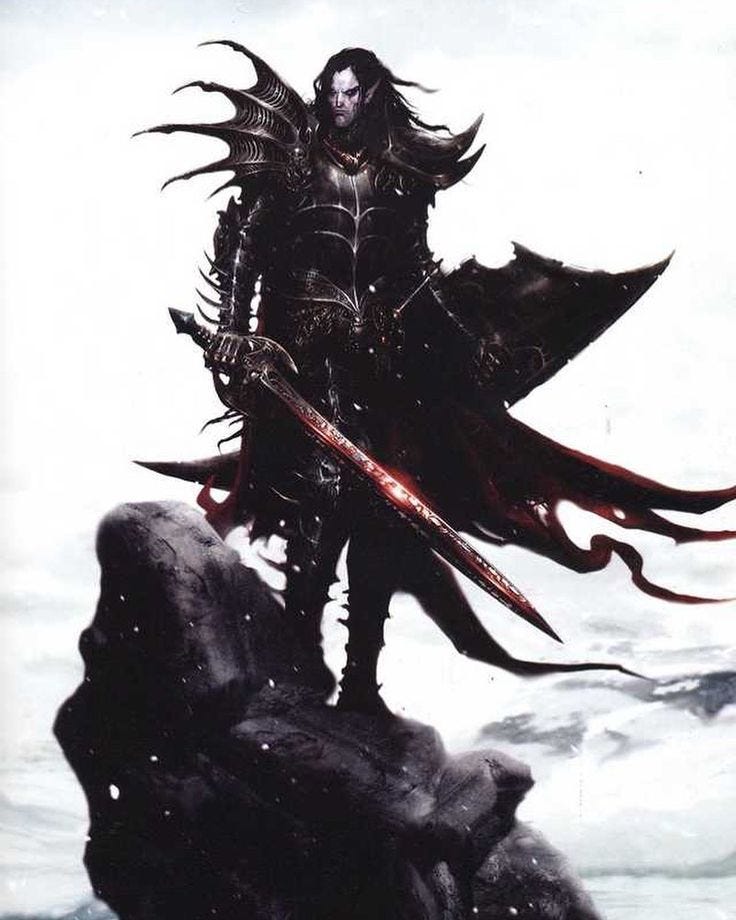
As noted above, Andrew James Spooner is a perfect Malus Darkblade. His anti-hero is dripping with venom, every bit exactly what you’d expect from a cutthroat highborn for whom the games of scheming and betrayal are as natural as breathing.
Very few of the voice actors I’ve enjoyed from the Black Library have quite the range to pull off a host of characters well, and Spooner is similarly a bit limited here. His Malus is unmistakable, but beyond that you’ll want to be actively listening to get the most from his performance.
The first part of the book, which involves Malus coming out on the receiving end of some manipulation and betrayal in Hag Graef, is a bit uneven. The quest structure here really gives the story purpose and direction, though, so once the table is set for the nautical quest to begin the story really begins in earnest- and never lets up.
Lee’s writing here is pure delight. He positions Malus like a gardener of dissent, with him moving through almost every scene or conversation planning the seeds of unrest or the latest twist on his schemes amongst his companions. Watching him navigate- and orchestrate- an ever-thickening web of deceit and betrayal was wickedly delicious1, with all of it leading up to a climax where every scheme comes to fulfillment. For every hand extended, there’s a dagger held in the other- and that applies just as much to Malus’s three siblings as well.
Indeed, Malus isn’t just scheming to get ahead. Each of the three have good reason to prefer him dead, and Malus quickly realizes that the best way to keep himself alive is to make sure their knives are pointed at each other. It’s a very delicate tightrope act, one that most assuredly does not have a net.
In addition, Malus is written with a great deal of internal deliberation. Stories with lots of schemes and plots run the risk of losing the reader in their intricacy, but Lee avoids that by letting the reader sit in on Malus’s thoughts. He doesn’t automatically know the right thing to do in every circumstance, but rather frequently needs to reason his way through events as they unfold. This has the effect of making the reader almost a silent partner, highly engaged in his decisions.
Finally, the further I explore the world of Warhammer Fantasy, the more maudlin I’ve grown about its passing a little over a decade ago. It really feels like something extraordinary was lost when the decision was made to destroy it and replace it with Age of Sigmar. That’s no knock on AoS, mind, and I know that the decision was in no small part guided by market data. But these are some wonderful stories tucked away in the less-frequented corners of the Black Library, and if you haven’t yet I hope you’ll give them a chance.
More than once I found myself laughing aloud, exclaiming “the balls on this guy”
I haven't read Bloodstorm in forever and I don't remember a whole lot but I remember Malus picking up a hilarious sidekick. A crooked city guardsman or something like that. He really made the novel for me. Also, I really wish that Lee could have brought some of his Darkblade magic to his Heresy output. Both Fallen Angels and Wolf at the Door have been underwhelming to say the least.